

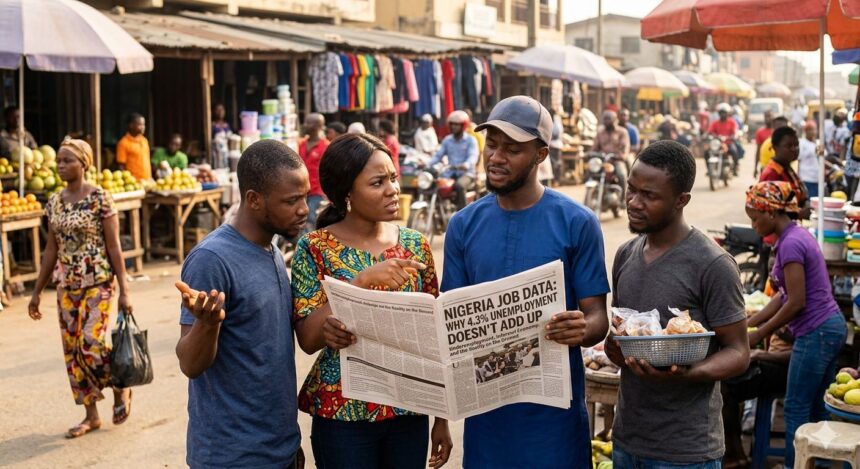
On paper, Nigeria’s unemployment rate stands at an enviable 4.3%, a figure that would signal near full employment in any developed economy. But on the streets of Lagos, Kano, and Port Harcourt, millions of graduates scramble for nonexistent jobs, factories shut down, and over 139 million Nigerians live in poverty. This contradiction is not an anomaly. It is the result of a fundamental crisis in how Nigeria measures and hides its economic reality.
Nigeria Deep Dive
Key actors
The crisis implicates three key institutions: the National Bureau of Statistics (NBS) , which has not published updated labour force data for over 14 months; the Budget Office of the Federation, which has failed to release budget implementation reports for three consecutive quarters; and the Fiscal Responsibility Commission, which remains largely ineffective at enforcing compliance.
Related News
Data dashboard
-
Official unemployment rate (Q2 2024): 4.3%, down from 33.3% in Q4 2020
-
Actual reality: Over 130 to 139 million Nigerians in poverty (World Bank, October 2025)
-
Missing budget reports: Q3 2025, Q4 2025, Q1 2026, unpublished
-
Revenue leakages (2023 to 2025): N34.53 trillion diverted before reaching Federation Account, which is 41% of total revenue
-
Data Quality Rating: “E, extremely poor quality, unusable for serious decision making” (World Economics, May 2026)
Policy failure score
Rating: Critical Failure
The NBS adopted a new unemployment methodology in 2023 aligned with International Labour Organisation standards. Under the old system, anyone working fewer than 20 hours weekly was unemployed. Under the new system, anyone working at least one hour in the past week is classified as employed.
Critics, including past CIBN President Segun Ajibola and Professor Akpan Ekpo, argue this masks Nigeria’s true employment crisis. “If you work for one hour a week, you are employed. That does not make any sense,” Ekpo told Dubawa. “The current figures suggest the country is at full employment, which is not true.”
The Nigeria Labour Congress called the 4.3% figure “fraudulent” and a “voodoo document.”
The Global Corridor
What does Argentina’s data crisis teach Nigeria?
Like Nigeria, Argentina has struggled with statistical credibility under reformist governments. The difference is that Argentina’s INDEC statistical agency underwent international audits and methodological transparency reforms. Nigeria’s NBS, by contrast, has remained opaque about its survey samples and refused to publish data using both old and new methodologies for comparison.
Egypt offers another parallel. Cairo’s rebased inflation figures drew similar skepticism until the central bank published dual track data, old and new methodologies side by side, for 12 months. Nigerian economists have urged the NBS to do the same. The agency has not responded.
What does the World Bank’s warning mean?
The World Bank’s Nigeria Development Update revealed that systemic “first line charges,” deductions made before revenues reach the Federation Account, have quietly eroded fiscal space. Between 2023 and 2025, agencies captured N34.53 trillion at source, more than the combined capital budgets of 2024 and 2025.
Peter Obi, former presidential candidate, described this as “institutionalised corruption on a massive scale.”
The Crossover Point
Where Nigeria contradicts global models: Unlike Ghana, which publishes quarterly budget implementation reports within 60 days of quarter end under its IMF program, Nigeria has abandoned statutory deadlines entirely. The Budget Office now offers no timeline for releasing missing Q3 2024 to Q1 2026 reports, citing “ongoing review and verification.”
The credibility cost: World Economics now rates Nigeria’s GDP and population data as “E, unusable for serious decision making,” citing “likelihood of Government interference” as a key factor. This rating puts Nigeria in the same category as conflict affected states, not peer emerging economies.
BudgIT deputy director Vahyala Kwaga told BusinessDay: “The federal government has broken its own laws on publication, transparency, that have completely closed the door for any form of accountability. Because how can you hold the government accountable when you do not know its financial position?”
6 Month Forward Look (Two Scenarios)
Baseline scenario (40% probability)
The NBS releases long overdue labour force data by Q3 2026, showing unemployment substantially higher than 4.3%. The Budget Office publishes Q2 2026 reports while leaving 2025 gaps unfilled. International lenders issue formal warnings but continue disbursements. Public trust remains eroded.
Worst case scenario (60% probability)
Selective transparency continues. The NBS cites “methodological refinement” to further delay labour data. Budget implementation reports remain unpublished through end of 2026. The World Bank and IMF condition future loans on fiscal transparency reforms, which Nigeria negotiates down. Investor confidence deteriorates. Credit rating agencies downgrade Nigeria’s sovereign rating, raising borrowing costs.
Human Angle
“We used to trust the numbers,” says Ibrahim, a 27 year old economics graduate in Kano who has been job hunting for 18 months. “Now, when they say unemployment is 4%, we laugh. In my neighbourhood alone, out of 30 graduates, maybe three have formal jobs. The rest survive on odd jobs, phone repairs, street trading, zero hour contracts. That is not employment. That is survival.”
The National Union of Chemical, Footwear, Rubber, Leather and Non Metallic Products Employees reported losing over 20,000 workers in one year as companies exited Nigeria’s harsh operating environment, yet official data showed unemployment falling.
Three Unanswered Questions (For Further Investigation)
-
Why will the NBS not publish labour data using both old and new methodologies side by side for even one quarter? This transparency step, recommended by Professor Akpan Ekpo, would immediately reveal the true scale of the employment crisis.
-
Which agencies captured the N34.53 trillion in pre distribution deductions between 2023 and 2025, and under what legal authority? The World Bank identified the leakages but Nigeria’s government has not named the benefiting agencies.
-
Will the Fiscal Responsibility Commission enforce Section 50 of the Fiscal Responsibility Act against the Budget Office? To date, no penalty has been imposed for violating statutory disclosure requirements, raising questions about whether Nigeria’s transparency laws have any enforcement mechanism.