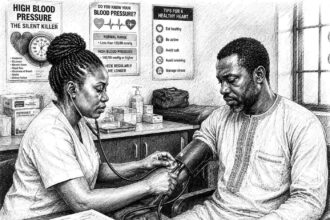


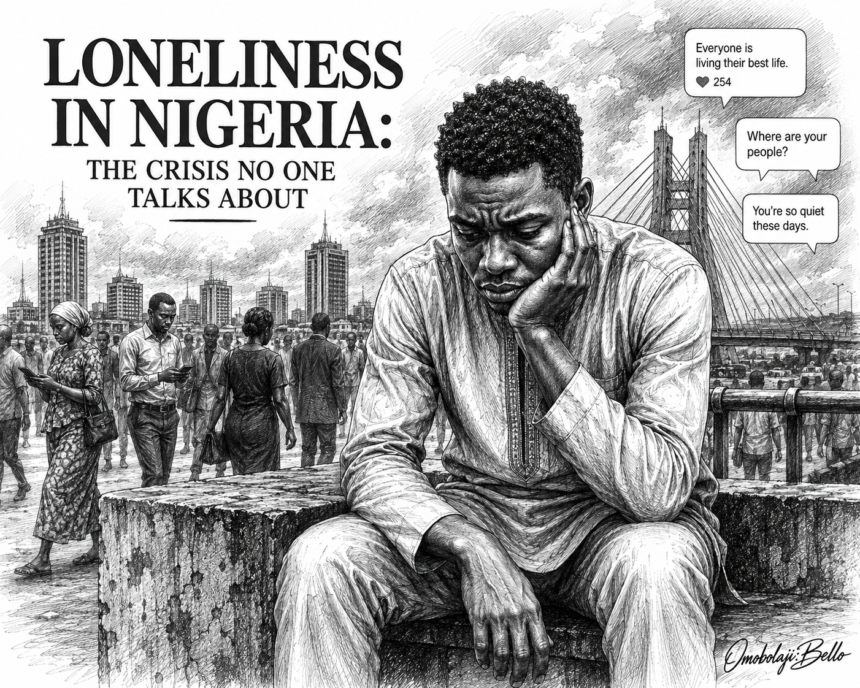
In 2023, the United States named loneliness a public health epidemic. A top US doctor said it openly. Half of all American adults feel lonely on a regular basis. Numbers like this now sit beside numbers for diabetes and high blood pressure on health reports.
Nigeria has not made the same announcement. No government office has called loneliness a crisis here. But walk through any big Lagos estate at 9pm. Look at the rows of locked gates. Listen to how quiet some streets get, even with millions of people nearby. The feeling is not hard to find. It is just hard to measure.
This piece looks at two groups carrying this weight in different ways. The first is older Nigerians, especially retirees, where real local research exists. The second is young people and remote workers, where the world has data but Nigeria does not — yet. Both groups deserve a closer look, and both have something to teach the other.
Related News
What “Loneliness” Actually Means
Loneliness is not the same as being alone. A person can live with ten family members and still feel lonely. Another person can live alone and feel completely fine. Researchers describe loneliness as a gap. It is the space between the connection a person wants and the connection a person actually has.
This matters for how we talk about it in Nigeria. Many Nigerian homes are full of people. Extended families often live close together. Visitors drop by without warning. On the surface, this looks like the opposite of isolation. But closeness in the same room does not always mean closeness in feeling. A retiree surrounded by grandchildren can still miss the daily contact with old colleagues. A young graduate working from a bedroom in Lekki can be on five WhatsApp groups and still feel unseen.
Related News
The Older Nigerian, Alone in a Full House
Start with the part of this story that has real numbers behind it.
A major study followed older Nigerians for two years. It found that close to one in five of them developed new loneliness during that time. A similar share carried loneliness the whole way through, year after year. This was not a small sample. Researchers drew it from a household survey covering a population of about 25 million people.
The same researchers found something important. People with depression at the start of the study were more likely to become lonely later. But the reverse was also true, and more hopeful: those with strong social ties were far more likely to recover from loneliness once it set in. Connection was not just protection. It was treatment.
A separate study from North-Central Nigeria looked only at retirees. It found a clear link between loneliness and feelings of depression and anxiety after people left work. This makes sense once you think about it. A job is not only about income. It is also a daily reason to leave the house, a group of familiar faces, a structure to the week. Take that away suddenly, without replacing it with something else, and the days can start to feel very long and very quiet.
Think about what a typical working life in Nigeria actually provides, without anyone planning it that way. There is the early morning greeting to a security man at the gate. The shared bus or okada ride with the same driver most mornings. The office canteen, where gossip and real talk mix together over a plate of rice. The end-of-month outing when salaries land. None of this gets listed as “social support” by the people living it. It simply happens, day after day, as a side effect of having somewhere to be.
Retirement removes all of it in one stroke, often on a single Friday afternoon. The retiree wakes up on Monday with nowhere that needs him and, just as importantly, no one expecting him. Multiply this by thousands of retirees leaving federal and state service every year across Nigeria, and the scale of the issue becomes clearer. It is not one or two unlucky individuals. It is a structural gap that opens up at a predictable point in nearly every working life.
Then COVID-19 made things worse. Researchers who reviewed studies on older adults across Africa during the pandemic found that isolation reached into nearly every part of life. It touched mental health, family closeness, money, faith, and physical health, all at once. Lockdowns cut off children’s visits. Markets closed. Churches and mosques moved online for those lucky enough to have data and a working phone. For many older Nigerians, that period did not end when the lockdowns lifted. The habits of staying inside, staying quiet, and staying apart stuck around.
What helped, even during the worst of it? Three things kept showing up in the research: family contact, community groups, and faith networks. Where these stayed active, even by phone, people coped better. Where they broke down completely, loneliness deepened.
The Younger Nigerian, Busy but Disconnected
Now the harder part to write, because the numbers are thinner.
Around the world, the picture for young workers is well documented. Global workplace data from 2026 shows that more than one in five employees felt lonely on most days. The number is worse for people under 35. It is worse again for those working fully from home, who report loneliness at far higher rates than people who go into an office. Burnout and loneliness now appear to feed each other. People who are burned out are about twice as likely to also feel lonely, and the two problems together cost employers heavily in missed work and people quitting their jobs.
Gen Z workers, those mostly under 28, report the steepest numbers. Some surveys show double the loneliness rate of Millennials in this age group. Many of them started their careers without ever experiencing an office full of colleagues, mentors at lunch, or casual desk conversation. They learned how to work before they learned how to belong at work.
Nigeria does not yet have a study that measures this the same way. There is no large national survey asking young Lagos tech workers, Abuja civil servants, or Port Harcourt freelancers how often they feel alone. This is a real gap, not a small one. But the absence of a number does not mean the absence of a problem.
Nigeria’s young workforce has grown fast in remote and freelance work. Tech hubs in Yaba and Lekki, customer service jobs done from home, freelance writing and design work sold abroad — all of this has multiplied in recent years. Many of these workers sit through long days with no office, no commute, and no small talk by a printer. Their main source of contact may be a laptop screen and a string of unread messages.
Add to this the everyday pressure of Nigerian city life. Long hours in traffic eat into time that could go toward friends and family. The high cost of going out — fuel, transport, even just airtime to call someone — quietly nudges people toward staying in instead of showing up. Economic pressure does not just strain wallets. It strains the small, ordinary moments where friendship usually grows: the shared meal, the weekend visit, the unplanned phone call that runs long.
There is also a quieter economic squeeze working in the background. As the cost of fuel and transport keeps climbing in many parts of the country, a simple visit to an old friend across town stops being simple. What used to be a short trip becomes a calculation: can this wait, is it worth the fare, would a voice note do instead? None of these decisions feel dramatic in the moment. But repeated often enough, across months and years, they quietly thin out a person’s circle of regular contact without anyone ever deciding to cut anyone off.
Migration adds another layer. Many young Nigerians now live far from where they grew up, chasing work in Lagos, Abuja, Port Harcourt, or abroad entirely. The friends from secondary school and university scatter across cities and time zones. Building a brand new circle of close contacts in an unfamiliar city, while working long hours and watching every naira, is hard work that often gets pushed to “later” indefinitely. Later rarely arrives on its own; it has to be chosen, again and again, against the pull of exhaustion and convenience.
Social media adds a strange twist. A young Nigerian can have thousands of online followers and still feel completely unseen by the people closest to them. Online closeness is not the same as offline closeness, and the gap between the two may be where a lot of quiet suffering hides.
Two Generations, One Shared Lesson
Put the older Nigerian and the younger Nigerian side by side, and a pattern appears. Both lose a daily structure that used to bring them into contact with other people. For the retiree, that structure was a job. For the remote worker, that structure was never built in the first place, or it vanishes the day they start working from a bedroom instead of an office.
Both groups also share a way out, based on what research keeps pointing to: rebuilding small, regular, low-effort contact. Not big events. Not deep, intense friendships overnight. Just small, repeated chances to be seen by another human being.
This is where Nigeria’s traditional strengths could actually serve it well, if used on purpose. Extended family networks, faith communities, and tight neighborhood ties are not new ideas here. They are old ones, already built into daily life. The work now is to point them at this specific problem, instead of assuming they will fix it automatically just by existing.
It helps to be honest about why these old structures sometimes fail anyway, even when they are technically still there. A large extended family can still leave one member quietly isolated inside it, especially if that person has moved away, lost a spouse, or simply stopped being asked along. A church or mosque with hundreds of members can still let a struggling person sit unnoticed near the back. Size and tradition are not automatic protection. Someone has to actually notice, actually reach out, and actually keep reaching out, more than once.
What Actually Helps — Without Costing Anything
None of the fixes below needs money. That matters in a country where many people are already stretching naira further than it wants to go.
Keep one weekly anchor point with another person. This does not need to be big. A Sunday phone call with a parent. A Thursday evening visit to a neighbor. A standing lunch with one old coworker. Research on recovery from loneliness keeps circling back to consistency, not intensity. One small, repeated contact beats one big gathering that happens once and never again.
Join something that meets in person, even briefly. A church group, a mosque study circle, a town union meeting, a football viewing center, a women’s cooperative, an old students’ association. These spaces already exist in almost every Nigerian community. They cost little or nothing to attend. The value is not the activity itself. It is the simple, repeated act of being around familiar faces.
For retirees, plan the exit from work like a project, not an event. Anyone nearing retirement can ask now: who will I still see weekly once the job ends? If the honest answer is “no one,” that is worth fixing months before the last day at work, not months after.
For remote workers, build in human contact on purpose. Set one video call a week that is not about a task or deadline, just a real conversation. Work from a shared space, a café, or a friend’s house some days instead of always alone at home. Small, deliberate choices like these can replace what an office used to provide automatically.
Watch for the people going quiet. Loneliness often hides well. People who are struggling rarely announce it directly. A short check-in message to someone who has gone quiet costs nothing and can mean more than the sender realizes.
The Bigger Picture
Step back, and the loneliness story is really a story about how fast Nigerian life is changing. Cities are growing. Families are spreading across cities, states, and countries. Work is moving online for a growing share of young people. Retirement is stretching longer as life expectancy slowly rises. Every one of these shifts can quietly chip away at the daily contact people used to take for granted.
None of this means connection is disappearing. It means it needs more attention than it used to, because it no longer happens automatically just by living in a busy city full of people. A packed bus, a noisy market, a crowded church service — none of these guarantee real connection, even though they all involve being surrounded by other people.
The good news sitting inside the research is this: loneliness, unlike many health problems, responds well to surprisingly simple steps. It is not a condition that always needs a hospital, a prescription, or a large sum of money. Often, it needs a phone call that actually happens, a visit that gets followed through on, a group that meets and keeps meeting.
There is also a wider lesson here for how Nigeria measures its own wellbeing. Health conversations in this country, understandably, tend to center on what can be seen and counted: malaria cases, hypertension readings, the price of a hospital bed. Loneliness resists that kind of counting, which may be exactly why it gets left out of the conversation so often. But the research from other countries, and the limited research already done here on retirees and older adults, both point out the same way: a person can be physically well cared for and still be suffering, quietly, from too little real contact with other people. That suffering deserves a place in the health conversation too, even without a thermometer or a blood test to prove it.
Nigeria is not short on the raw materials for connection. Family ties run deep here. Faith communities are active and present. Neighborhoods still know their own people, in many places, in a way that has faded elsewhere in the world. The task ahead is not to invent something new. It is to notice who has quietly slipped through the cracks of all that existing closeness, and to reach back out to them, on purpose, before the gap grows wider.
Where to Get Help
If loneliness has turned into something heavier — ongoing sadness, hopelessness, or thoughts of self-harm — free and confidential support is available in Nigeria:
- Mentally Aware Nigeria Initiative (MANI) — 24/7 support, focused on young people
- SURPIN — national suicide prevention support line
- She Writes Woman — toll-free mental health helpline: 0800 800 2000
This article is for general information. It is not a replacement for professional medical or mental health advice.