

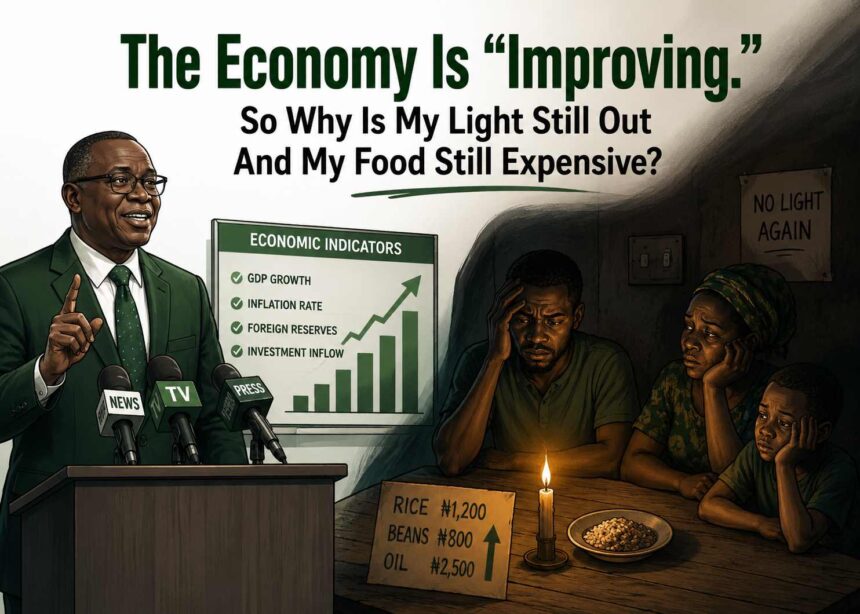
The experts gathered at the Nigerian Bar Association conference last week. They discussed GDP growth. They discussed investment flows. They discussed macroeconomic reforms. They agreed that Nigeria’s economy is showing signs of improvement. Then they went home to their generators. They paid inflated prices for imported food. They sat in traffic caused by poorly maintained roads. And somewhere between the conference hall and reality, the disconnect became clear. The economy may be improving on paper. On the ground, Nigerians are still suffering.
Here is what most people get wrong about Nigeria’s economic reforms. The problem is not that the reforms are failing. The truth is that the benefits of the reforms are not reaching ordinary people because of structural problems like power shortages, inflation, and unemployment. And here is why that matters right now: because an economy that grows on paper while citizens suffer on the ground is not a successful economy. It is a statistical illusion.
President Tinubu has signed four landmark tax laws. The exchange rate has been liberalized. The fuel subsidy has been removed. These are significant reforms. International investors have noticed. The GDP numbers are moving in the right direction. But the panellists at the NBA conference were honest. They said policymakers must look beyond macroeconomic indicators and focus on the realities confronting households and businesses.
Related News
Macroeconomics is for economists. Microeconomics is for everyone else. And the microeconomy is broken.
The experts identified Nigeria’s chronic electricity deficit as one of the biggest threats to economic transformation. Productivity, industrial growth, and competitiveness will remain constrained until the power crisis is addressed. That is not speculation. That is fact. A factory that runs on diesel cannot compete with a factory that runs on the grid. A small business that spends half its revenue on fuel cannot grow. A student who studies by candlelight cannot compete with a student who studies by LED.
Let me give the government its due. The reforms are bold. Successive administrations have avoided touching fuel subsidy and exchange rate liberalization because they were politically dangerous. This administration did it. That takes courage. And some of the early indicators are positive.
Related News
But here is where that defense fails. Courage without results is just theater. The experts at the NBA conference were clear. Sustainable growth will remain elusive unless the real sector is empowered to create jobs and expand productive capacity. That means electricity. That means security. That means roads. That means policies that help small businesses survive, not just policies that attract foreign portfolio investors.
You cannot eat GDP growth. You cannot light your home with investment flows.
I know a woman who runs a small catering business in Lagos. She used to bake 100 loaves of bread per day. Now she bakes 40. Why? Because her generator consumes so much fuel that her profit margin has disappeared. She cannot raise her prices because her customers cannot afford it. She cannot lower her costs because the power company cannot keep the lights on. She is trapped. She is not in the GDP statistics. She is just another Nigerian struggling to survive.
She is not alone. Millions of small business owners across the country face the same reality. They are the backbone of the economy. And they are being crushed by structural problems that the government seems unable or unwilling to solve.
The government must recognize that macroeconomic reforms are not an end in themselves. They are a means to an end. The end is a better life for ordinary Nigerians. That means investing in power generation and distribution. That means creating jobs. That means bringing down inflation so that families can afford food. That means security so that farmers can return to their fields.
The tax reforms are a good start. But a start is not enough. The government must follow through. It must prioritize the real economy over the financial economy. It must measure success not by GDP growth alone, but by whether Nigerians can afford to feed their families and keep their lights on.
Here is where we land. The economy is “improving.” So why is my light still out and my food still expensive? Because the economy that is improving is not the economy that I live in. The government talks about reforms. I talk about survival. Until those two conversations become the same conversation, the experts will keep conferencing, and Nigerians will keep suffering. And the gap between the headline and the reality will keep growing.