

She did not feel sick. That is what 52-year-old Adeola, a Lagos trader, kept saying after her Type 2 diabetes diagnosis. She had been tired. She drank water constantly. She used the bathroom more times at night than she could count. But sick? No. She was eating well, she thought. She was managing.
What she did not know was that her blood sugar had been climbing for years, quietly and without pain, while her daily meals did exactly what they were designed to do. Feed her. And also, slowly, damage her.
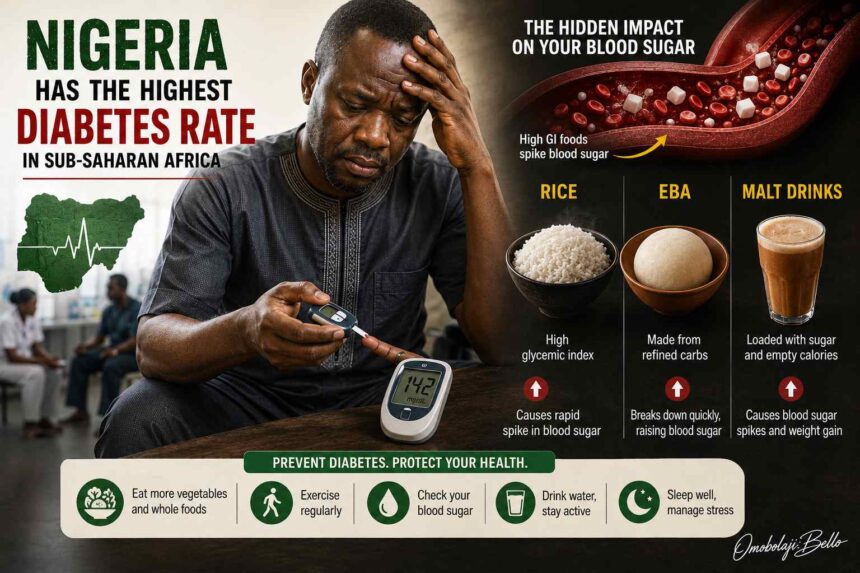
Her story is not unusual. Nigeria now has the highest rate of diabetes in sub-Saharan Africa. An estimated 11 million Nigerians have the condition and do not know it. And the food on most Nigerian tables, the rice, the eba, the cold malt at a party, the dodo on the side, is at the centre of why that number keeps going up.
Related News
The Numbers Are Bigger Than the Government Admits
The official figures undercount the problem. The International Diabetes Federation put Nigeria’s diabetes prevalence at 3.6 to 3.7 percent of adults in recent years. But a major peer-reviewed meta-analysis published in December 2024, which pooled data from 60 Nigerian studies across all six geopolitical zones and over 124,000 participants, found the real prevalence to be 7 percent, nearly double the official estimate.
In some parts of the country, the picture is even worse. Studies in the South-West found prevalence as high as 10.7 percent in certain communities. A 2025 cross-national study using WHO screening tools found that 7 percent of survey participants in Nigeria had diabetes, with another 15.8 percent in the prediabetes range. That means roughly 43 percent of some Nigerian communities are now at risk of crossing the line.
Related News
READ ALSO:
- Nigeria’s Future Workforce Depends on Digital Skills, Preventive Healthcare, Regulators Say
- Tinubu Creates National Health Technology Office, Names Adigwe Coordinator
- Nigeria Senate Passes Digital Health Bill to Improve Healthcare Access
The South-South zone had the highest regional prevalence at 11.35 percent. North-Central had the lowest at just over 2 percent. The difference between zones reflects differences in diet, lifestyle, and urban density, not genetic luck.
Two-thirds of Africans with diabetes are undiagnosed. In Nigeria, that figure may be even higher. Experts at Duchess International Hospital in Lagos estimate that 11 million Nigerians are currently living with undiagnosed diabetes. Many will only find out when a complication forces them into a hospital, by which point the damage to eyes, kidneys, or feet may already be serious.
Prof. Felicia Anumah, one of Nigeria’s leading diabetes experts and the country’s representative to D-Foot International, put it plainly in June 2026. A journalist suggested to her that diabetes in Nigeria felt like a ticking time bomb. She did not agree.
“The bomb,” she said, “has already exploded.”
What Is Happening Inside Your Body
To understand why food matters so much in this story, it helps to understand what diabetes actually is.
When you eat carbohydrates, rice, bread, eba, plantain, yam, your body breaks them down into glucose, which enters your blood. Your pancreas responds by releasing insulin, a hormone that acts like a key, opening your cells so they can absorb that glucose and use it for energy. In a healthy body, this system works smoothly. Blood sugar rises after a meal and comes back down within a couple of hours.
In Type 2 diabetes, this system breaks down. The body’s cells stop responding properly to insulin. The pancreas tries to compensate by making more, but over time it cannot keep up. Blood sugar stays high. And sustained high blood sugar is, slowly and relentlessly, toxic to almost every organ in the body.
It damages the tiny blood vessels in the eyes, causing diabetic retinopathy, the leading cause of blindness among working-age adults worldwide. It attacks the kidneys, causing nephropathy, which leads to kidney failure. It destroys nerve endings in the feet, causing diabetic neuropathy, which means a person can develop a wound on their foot and not feel it. That wound gets infected. The infection spreads. And then a surgeon has to remove a leg.
This is not a rare or extreme outcome in Nigeria. Diabetes is the most common cause of non-traumatic limb amputation in this country. Experts warn that teenagers are now developing diabetes and are at higher risk of all these complications at a younger age than any previous generation.
The WHO projects that diabetes will be the seventh leading cause of death globally by 2030. In Africa, premature deaths from diabetes, deaths before the age of 70, already stand at 58 percent, higher than the global average of 48 percent. This is not a future problem. It is a present one.
The Nigerian Plate: What the Research Actually Says
Now for the part that touches every household in this country.
Nigeria’s diet is built on carbohydrates. This is not an accusation. It is a description of a food culture shaped by agriculture, history, taste, and tradition. The problem is not that Nigerians eat carbohydrates. The problem is the type, the processing level, and the sheer portion size, and the way that combination interacts with a body that was not designed for it at this scale.
White rice is the most significant single food in this conversation. Harvard researchers who reviewed studies covering more than 352,000 people across four countries found that people who ate three to four servings of white rice per day were 1.5 times more likely to develop diabetes than those who ate the least. For every additional large bowl of white rice eaten daily, the risk of diabetes rose by 10 percent. Nigeria’s per capita rice consumption has grown significantly over recent decades. The typical serving size on a Nigerian plate, not a small bowl by any measure, delivers a large glucose load in one sitting.
White rice is a refined grain. The bran and germ, which contain fibre and slow down digestion, have been removed. What remains is essentially pure starch that the body converts to glucose very quickly. This causes a sharp spike in blood sugar. Repeated, day after day, year after year, this constant spiking wears down the body’s insulin response.
Swallows tell a similar story. Eba made from highly processed garri, semovita, and pounded yam from instant flour are all refined carbohydrates. Their natural fibre has been stripped away during processing. They digest fast, hit the bloodstream fast, and push blood sugar up fast. The portion sizes Nigerian culture encourages do not help. Reducing the swallow and increasing the soup, especially vegetable-rich soups like efo riro, egusi with plenty of vegetables, or edikaikong, changes the equation meaningfully.
Dodo is worth a specific mention. As plantain ripens, its starch converts progressively to sugar. Ripe fried plantain starts with a high-sugar base, then adds oil from frying. It is a combination that raises blood sugar quickly and provides little that slows it back down.
Then there are the drinks. A cross-country study published in October 2025, tracking sugar-sweetened beverage sales across nine African countries from 2010 to 2024, found that Nigeria recorded a 119 percent increase in per capita SSB sales over that period, the second sharpest rise in the group, behind only Cameroon. Malt drinks, Chapman, bottled fruit juice, and soda are all consumed in large quantities at Nigerian celebrations, in offices, and with everyday meals. They deliver significant sugar loads without triggering the same fullness signal that solid food does, meaning people consume far more sugar from drinks than they realise.
Who Is Most at Risk in Nigeria
The December 2024 meta-analysis identified the strongest risk factors for Type 2 diabetes among Nigerians. Family history came first, with an odds ratio of 9.73, meaning a Nigerian with a parent or sibling who has diabetes is nearly ten times more likely to develop it than someone without that history. High socioeconomic status came second, at 6.72, which reflects the pattern seen across developing economies: wealthier Nigerians eat more processed food, move less, and sit in cars and offices longer than their lower-income counterparts.
Physical inactivity had an odds ratio of 5.92. Urban living, 4.79. Being overweight, 3.07. Not eating vegetables frequently, 2.68. Abdominal obesity, 1.81.
Read that list and a picture forms of a specific kind of Nigerian life: city-based, relatively comfortable, driving rather than walking, eating from restaurants and canteens, drinking cold malt at every occasion, carrying weight around the middle, and almost never having vegetables as a meaningful part of daily meals.
This is not a description of the poorest Nigerians. It is a description of the aspiring middle class, the civil servants, the traders, the office workers, the business owners. The people who believe that their lifestyle represents success. And it is exactly this group that Nigeria’s diabetes surge is eating through most aggressively.
Age over 45 is also a significant risk factor. But the alarming trend cardiologists and endocrinologists are watching is the downward shift in age at diagnosis. The condition that was once associated with people in their fifties and sixties is now walking regularly into clinics in thirty-year-olds. Some studies are now reporting it in teenagers.
The Cost of Getting It Wrong
If the health consequences of unmanaged diabetes do not land with enough weight, the financial ones might.
A Guardian Nigeria investigation published on World Diabetes Day in November 2024 put the average monthly cost of diabetes care at over ₦100,000 for a Nigerian patient. Since 2023, the cost of insulin has risen by more than 200 percent. A single vial of insulin now costs between ₦18,000 and ₦21,000, up from ₦3,500 a few years ago. A pack of Lantus insulin that cost ₦22,000 now costs ₦58,000. Common oral anti-diabetic drugs have seen similar increases.
Nigeria currently has approximately one endocrinologist for every 600,000 people. There are just two podiatrists, foot specialists, in the entire country. These are the specialists who catch diabetic foot problems before they become amputations. Two, for over 220 million people.
Prof. Anumah, who leads the Diabetic Foot Nigeria Initiative, organised a three-day conference in Abuja in April 2026 specifically to bring plastic, orthopaedic, and vascular surgeons into the conversation about limb loss. Her point was direct: collaboration between endocrinologists and surgeons is what saves legs. The fact that this collaboration has to be built almost from scratch tells you how far the healthcare system has to go.
For families already stretched by economic pressure, a single diabetes diagnosis can be catastrophic. Patients skip doses when money runs out. They disappear from clinics and reappear only when a complication has become impossible to ignore. By then, the options are fewer and more drastic.
Prevention is not just the healthier option. For most Nigerians, it is the only affordable one.
What You Can Do, Food First, Then Everything Else
The single most powerful thing most Nigerians can do about diabetes is change what they eat. Not dramatically. Not expensively. Consistently.
Reduce your rice portion, do not eliminate it. The goal is not to stop eating rice. The goal is to eat a smaller portion and fill the rest of your plate with protein and vegetables. A serving the size of your clenched fist is a reasonable guide. Switch to Ofada rice or Abakaliki rice when possible, these are less refined and slower to digest than the polished white rice most Nigerians eat daily.
Change the ratio in your swallow meal. The typical Nigerian plate puts most of the space on the swallow and a smaller amount on the soup. Reverse this. Eat less swallow, more soup, especially soups packed with vegetables and protein. Consider swallows made from oatmeal, whole wheat flour, or unripe plantain flour, which are higher in fibre and digest more slowly.
Stop drinking your sugar. Malt drinks, soda, bottled juice, and Chapman are among the most efficient ways to push blood sugar up fast without triggering fullness. Replace them with water, zobo without added sugar, kunu, or fresh fruit that still has its fibre. If you drink a cold malt every day, cutting that single habit significantly reduces your daily sugar load.
Eat your vegetables first. Research consistently shows that eating vegetables before the carbohydrate portion of a meal significantly blunts the blood sugar spike. Start with the efo, the okra, the garden egg stew. Then eat the rice or swallow. This simple reordering changes how quickly glucose enters your bloodstream.
Move your body for 30 minutes a day. Exercise makes your cells more sensitive to insulin. This is one of the most direct and powerful ways to reduce diabetes risk and, for people already diagnosed, to improve blood sugar control. It does not require a gym. Walking counts. A consistent 30-minute walk five days a week is enough to make a real difference over time.
Know your family history and act on it. If a parent or sibling has diabetes, your risk is nearly ten times higher than someone with no family history. This is not fate. It is a warning that requires earlier and more frequent screening, and tighter attention to the lifestyle factors that are within your control.
Check your blood sugar. This year. A fasting blood glucose test at any pharmacy or primary health centre costs very little. A random blood sugar test costs even less. You cannot manage what you do not know. Given that 11 million Nigerians are currently undiagnosed, the odds that someone you know is in that group are not small. Get tested. Ask your family members to get tested too.
The Bigger Picture: A Disease Nigeria Can Still Bend
Type 2 diabetes is unusual among serious chronic diseases in one critically important way: it is largely preventable, and in its early stages, sometimes reversible. This is not true of most cancers. It is not true of most heart conditions. But diabetes, caught early enough, can be pushed back with lifestyle changes alone, no drugs, no surgery, no expensive intervention.
The 2024 meta-analysis was clear on this point: early identification of risk factors and lifestyle modification are the most effective tools available to reduce the rising prevalence of Type 2 diabetes in Nigeria. Not new hospitals. Not imported drugs. Lifestyle. Food. Movement.
That does not mean the healthcare system failures are acceptable. Nigeria needs more endocrinologists. It needs more podiatrists. It needs insulin on the essential medicines list and in public hospital pharmacies at prices ordinary people can afford. The Diabetes Association of Nigeria and other advocacy groups are pushing on these fronts, and they are right to do so.
But while those systemic fights continue, individuals have real power in this specific disease. The food choices made in kitchens and at canteen counters every single day are not small decisions. They compound. A person who reduces their rice portion and adds vegetables to every meal for five years is a meaningfully different health risk than the same person who does not.
Nigeria’s plates have changed dramatically in one generation. More processing. More refined carbohydrates. More sugar in drinks. More sitting. The body has not caught up with the change, and the diabetes numbers are showing it.
The answer is not to abandon Nigerian food culture. It is to return it, in part, to what it was before processing stripped out the fibre and portion sizes ballooned. Beans. Local grains. Whole vegetables. Fresh fruit. Less malt, more water. Smaller rice, more soup.
These are not foreign ideas. They are old Nigerian ones. And they may be the most important health intervention most Nigerians can make today.
Know Your Blood Sugar: Where to Get Tested
Free or low-cost blood sugar screening is available at the following locations in Nigeria:
- Any primary health centre (PHC) in your local government area
- Community pharmacies, fasting blood glucose tests are widely available at low cost
- Hospital outpatient diabetes clinics, most state hospitals run dedicated clinics
- Diabetes Association of Nigeria events and outreach screenings, diabetesnigeria.org
- NHIA-registered facilities for enrolled members, check eligibility at nhia.gov.ng
This article is for general information only. It is not a replacement for professional medical advice, diagnosis, or treatment. If you have symptoms of diabetes or a family history of the condition, speak with a qualified health professional as soon as possible.