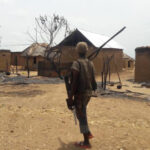



ABUJA — Defence Minister Christopher Musa has given President Bola Tinubu’s administration a 70 percent rating on security after three years in office. The minister made the declaration in a Democracy Day interview, citing major military operations, the killing of ISIS commander al-Minuki, and the ongoing court martial of coup plotters as evidence of the administration’s security achievements.
Musa said the remaining 30 percent reflects the ongoing challenges that security forces are working to address. He acknowledged that school abductions, banditry in the northwest, and the spread of JAS terrorists into the southwest represent serious unresolved threats. He said the government is not satisfied and will continue to intensify operations.
“We have made significant progress. The killing of al-Minuki, the court martial of coup plotters, the rescue operations in the northeast, these are not small achievements. But we know there is more to do. 70 percent is an honest reflection of where we are,” Musa said.
Related News
The 70 percent rating was immediately challenged by opposition figures and security analysts. They said scoring 70 percent while hundreds of schoolchildren remain abducted, while farmers cannot access their land in multiple states, and while terrorists are now active in the southwest reflects a government that has lost its sense of proportion.
The Opposition’s Counter
Peter Obi said on his Democracy Day message that Nigeria’s politicians, including those in the security establishment, have lost touch with the reality of ordinary citizens’ lives. He said a government that rates itself 70 percent on security when kidnapping is rampant across the country is demonstrating the kind of disconnect that drives citizens away from democratic participation.
Related News
Labour Party and ADC spokespeople issued similar critiques. They pointed to the more than 400 schoolchildren still in captivity from various abductions, the daily reports of kidnappings on Nigerian highways, and the continued displacement of millions of farming communities as evidence that 70 percent is a wildly generous self-assessment.
Furthermore, security researchers at the Council on Foreign Relations Nigeria Office published a Democracy Day review noting that Nigeria’s insecurity has become more geographically dispersed under the current administration. Threats that were previously concentrated in the northeast and northwest have spread to the north-central, southwest, and southeast. They said this dispersal represents a deterioration, not an improvement.
What the Military Has Achieved
To be fair to the minister’s assessment, the military has achieved genuine successes under the Tinubu administration. The joint Nigeria-US strike that killed al-Minuki is a landmark. The rescue of 92 civilians from Boko Haram in Borno State in May alone is significant. The court martial of 36 officers accused of coup plotting shows institutional accountability that was often absent in previous administrations.
However, these successes have not translated into tangible safety improvements for most Nigerians. Metrics that matter to citizens, including kidnapping incidents per month, road safety on major highways, and school attendance rates in conflict-affected areas, have not shown consistent improvement.
The 70 percent rating debate is ultimately a political as much as a security question. With the 2027 election approaching, how Nigerians assess the government’s security performance will be a major determinant of their voting choices. Tinubu’s administration needs that number to feel credible to voters, not just to ministers.