

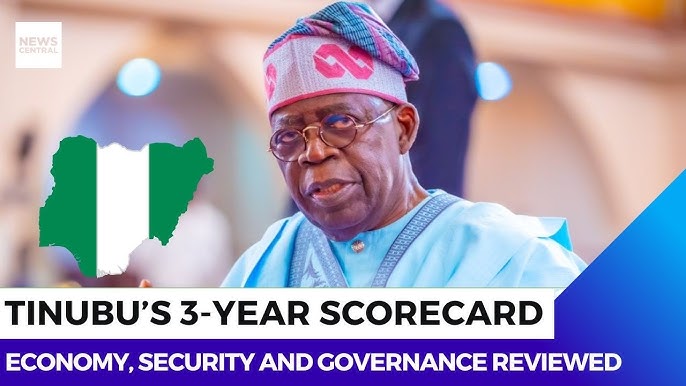
LAGOS — Vanguard Newspapers’ Board of Editors has released a comprehensive assessment of President Bola Ahmed Tinubu’s three-year administration. The report, published to mark the third anniversary of Tinubu’s inauguration, evaluates his performance across 12 key sectors including education, health, the judiciary, fiscal policies, insecurity, religious harmony, sports, politics, infrastructure, corruption, agriculture, oil and gas, and power.
Vanguard General Editor Jide Ajani, who coordinated the assessment, said the editorial board concluded that there is limited agreement across sectors that Tinubu is trying his best but that the results remain insufficient relative to the scale of Nigeria’s challenges. The assessment is neither a celebration nor a condemnation but a candid sector-by-sector review.
On the economy, the board acknowledged significant macroeconomic improvements including the S&P credit rating upgrade, foreign reserves crossing $50 billion, and the positive impact of the Dangote Refinery. However, editors noted that these improvements have not yet been felt in the daily lives of most Nigerians. Food inflation remains high. Unemployment is elevated. Poverty has worsened since the subsidy removal.
Related News
On infrastructure, the board gave a more positive assessment. Major road contracts have been signed. The Abuja-Kaduna rail remains operational. Several states have seen increased federal road rehabilitation activity. However, the Power sector continues to underperform, with electricity generation and distribution remaining far below what Nigeria needs.
Security: A Failing Grade
Security received the harshest assessment. Editors noted that despite the dramatic killing of ISIS commander al-Minuki in the Lake Chad basin and multiple military operations, ordinary Nigerians continue to face kidnapping, banditry, and terrorist attacks across multiple regions. The school abductions in Oyo and Borno during his third year were cited as evidence that fundamental security failures persist.
Related News
The ongoing coup plot trial was also mentioned as a jarring reminder that democratic stability cannot be taken for granted. Editors said the government must invest more in community-level security and address the underlying social and economic drivers of armed group recruitment.
On corruption, the board said the EFCC has been active but selective. High-profile prosecutions of opposition figures have overshadowed enforcement actions against APC-aligned individuals. Editors said genuine anti-corruption work requires institutional independence that appears compromised when targets consistently appear to be political opponents.
What Three Years Has Shown
The Vanguard assessment found genuine progress in some areas including the macro-economy, select infrastructure projects, and Nigeria’s international diplomatic profile under Tinubu. However, it found persistent failure in security, electricity, food security, and corruption control.
Editors concluded that Tinubu’s third year has been a year of consolidation for his reform narrative but not yet a year of breakthrough for ordinary Nigerians. They said the fourth year, which will be shaped by the approaching 2027 election, will determine whether the administration’s story ends as a genuine reform success or as a promising start that ran out of time and political will.
The assessment has been widely circulated on Nigerian social media. Supporters of the administration praised what they see as a fair acknowledgment of genuine progress. Critics said the board was too gentle on a government that has presided over declining living standards for millions of Nigerians.