

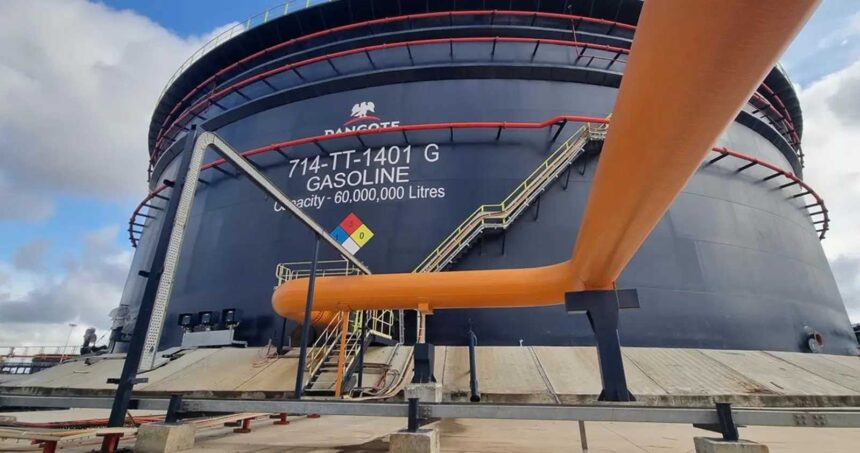
The Dangote Petroleum Refinery has announced a sharp reduction in petrol price to ₦1,075 per litre, a move that is already reshaping Nigeria’s downstream oil market.
The refinery, Africa’s largest, also declared that sales are now open to all registered marketers, ending weeks of speculation about restricted access. This decision is expected to ease supply bottlenecks and stabilise retail prices across the country.
Industry stakeholders say the price cut is significant, considering that petrol had recently sold above ₦1,200 per litre in many parts of Nigeria. The reduction offers relief to consumers and signals a shift in market dynamics, with Dangote’s entry challenging traditional import-dependent supply chains.
Related News
Announcing the new price, refinery officials explained that the decision was driven by efficiency gains and a commitment to make fuel more affordable. They stressed that the refinery’s scale allows it to refine crude locally at competitive rates, reducing reliance on foreign imports and volatile exchange rates.
Marketers welcomed the announcement, describing it as a breakthrough for the sector. The Independent Petroleum Marketers Association of Nigeria (IPMAN) said the open access policy would ensure wider distribution and prevent monopolistic practices. “This is a positive development. With more marketers able to buy directly, supply will improve and consumers will benefit,” an IPMAN representative noted.
For consumers, the immediate impact is expected to be felt at filling stations. Analysts predict that pump prices could drop further as competition among marketers intensifies. However, they caution that transportation costs and logistics challenges may still influence final retail prices in some regions.
Related News
Economists argue that the refinery’s move could have broader implications for Nigeria’s economy. Lower fuel prices may ease inflationary pressures, particularly in transport and food sectors. They also highlight the potential for improved foreign exchange stability, as reduced imports lessen demand for dollars.
The government has welcomed the development, describing it as a step towards energy security. Officials noted that local refining aligns with national goals of reducing dependence on imported petroleum products.
Despite optimism, challenges remain. Distribution infrastructure, including pipelines and depots, requires significant upgrades to ensure efficient delivery nationwide. Without improvements, rural areas may not immediately benefit from the price reduction.
Civil society groups have urged transparency in the refinery’s operations, calling for clear communication on pricing and supply. They argue that accountability is essential to prevent exploitation and ensure that consumers truly benefit from the refinery’s capacity.
The Dangote Refinery, commissioned in 2023, has been seen as a game-changer for Nigeria’s energy sector. With a capacity of 650,000 barrels per day, it is designed to meet domestic demand and export surplus products.
As sales open to all marketers, the refinery’s role in shaping Nigeria’s fuel market is becoming clearer. The price cut to ₦1,075 per litre marks a turning point, offering hope for stability in a sector long plagued by volatility.
For Nigerians, the expectation is simple: affordable fuel, consistent supply, and a market that finally reflects the benefits of local refining.