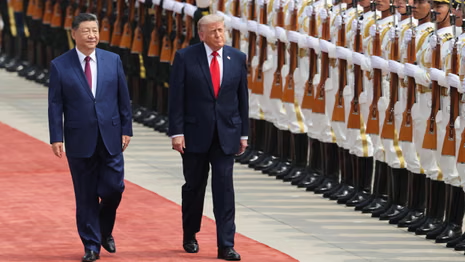


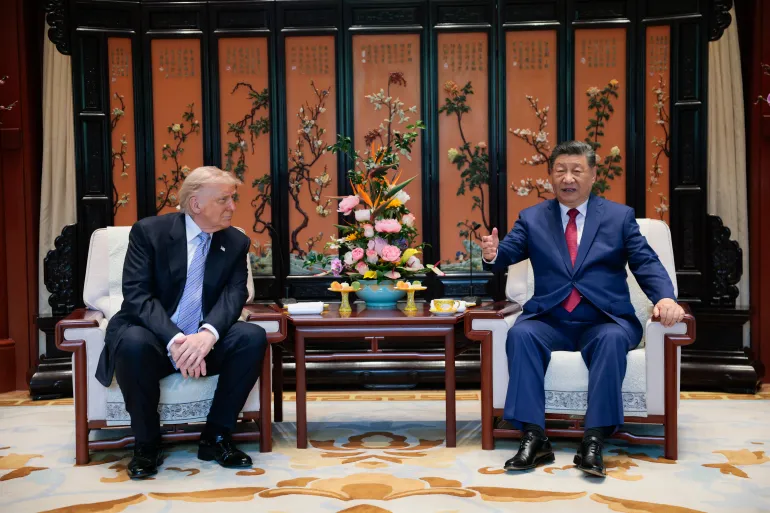
BEIJING — United States President Donald Trump and Chinese President Xi Jinping opened a two-day summit in Beijing on Thursday. The talks cover a broad range of issues including trade tariffs, Taiwan, artificial intelligence, rare earths, and the ongoing war involving Iran.
The summit is the first visit by a sitting US president to China in nearly a decade. It comes at a moment of significant global uncertainty, with Middle East conflicts disrupting energy markets and the global economy facing pressure from years of US-China trade tensions.
Trump and Xi met at the Great Hall of the People in Beijing. Xi warned Trump during the opening session that mishandling the Taiwan issue would put the US-China relationship in serious jeopardy. Both leaders agreed to maintain open communication on the matter.
Related News
On trade, analysts say both sides are expected to discuss a possible extension of the October 2025 trade agreement that reduced tariffs on Chinese goods and gave the United States access to critical minerals. Despite that deal, Chinese exports to the US continued to fall by 11 percent in early 2026.
China has responded to US trade pressure by diversifying its markets. In the first two months of 2026, China’s exports grew by 21.8 percent year-on-year as it redirected trade flows away from the United States and toward other global markets.
Justin Feng, Asia economist at HSBC, said the summit could mark a turning point. “The US, China, and the European Union now account for 60 percent of global GDP. A stabilization in their relationship would be significant for the entire global economy,” Feng said.
Related News
For Africa, the outcome of the Trump-Xi summit has direct implications. China is Africa’s largest trading partner and a major source of infrastructure investment. Any shifts in global trade flows resulting from the summit could affect African commodity prices and investment patterns.
Nigeria, which imports significant quantities of goods from China and depends on global oil prices heavily influenced by US and Chinese demand, is among the African countries monitoring the summit closely. Nigerian economists say stability between the two superpowers would help support the naira and Nigeria’s export revenues.
The second day of talks is expected to focus more specifically on technology, AI governance, and security cooperation. A joint statement from both governments is anticipated before Trump departs Beijing on Friday.