


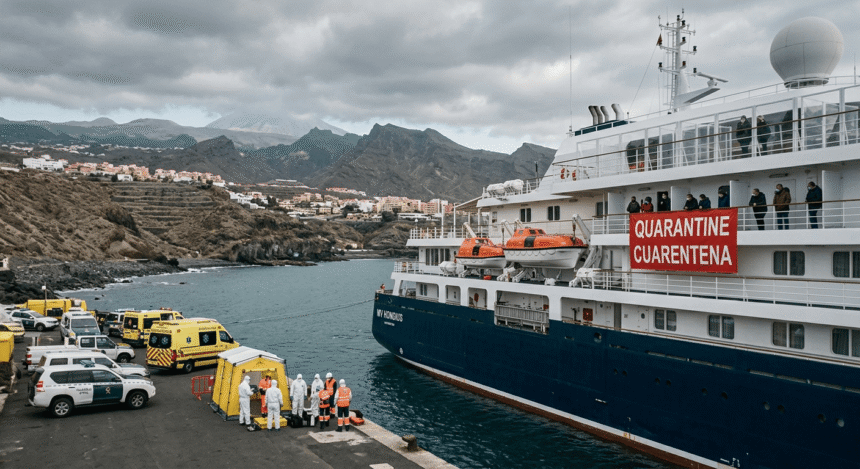
Deep in the South Atlantic, a luxury expedition vessel designed for the world’s most remote frontiers has become a floating laboratory of epidemiological dread. The MV Hondius, a state-of-the-art cruise ship, is currently cutting through the waves toward Tenerife, Spain. But it carries more than its 147 passengers and crew; it carries a rare, lethal pathogen that has already claimed three lives and forced a multi-national maritime standoff.
The “Hantavirus Cluster,” as the World Health Organization (WHO) has officially dubbed it, has shattered the peace of what was supposed to be a journey of a lifetime. As the ship nears the Canary Islands, the world is watching: is this a tragic localized event, or a warning sign of a new era of viral mobility?
Related News
The Voyage of the Index Case
The tragedy began in late March 2026. The MV Hondius departed Ushuaia, Argentina—the “End of the World”—aiming for the rugged beauty of the Atlantic islands. On April 6, an adult male passenger reported a fever and mild gastrointestinal distress. By April 11, the “mild” symptoms had transformed into a violent, suffocating respiratory failure. He died that same day.
“The Andes virus is an outlier. In the close quarters of a cruise ship, the barrier between an animal-borne accident and a human outbreak disappears.” — Dr. Elena Rossi.
The ship’s isolation was its undoing. Over the following weeks, six more cases emerged. A Dutch couple and a German national are now among the dead. The vessel, once a symbol of high-end adventure, was transformed into a cordon sanitaire off the coast of Cabo Verde, which refused the ship entry.
Related News
The Science of the Andes Strain: A Rare Exception
To understand the panic, one must understand the biology. Most Hantaviruses, like the Sin Nombre strain common in North America, are “dead-end” infections: they jump from rodents to humans but stop there.
The culprit aboard the MV Hondius is different. Laboratory results from South Africa have confirmed the presence of the Andes strain (ANDV). Native to the forests of Argentina and Chile, the Andes strain is the only Hantavirus known to be capable of human-to-human transmission.
“The Andes virus is an outlier,” explains Dr. Elena Rossi, an infectious disease specialist. “It lingers in high concentrations in respiratory secretions during the early stages. In the close quarters of a cruise ship, sharing cabins, dining halls, and recycled air the barrier between an animal-borne accident and a human outbreak disappears.”
Present Status: The Approaching Storm in Tenerife
As of today, May 7, 2026, the Spanish Health Ministry has made the controversial decision to allow the MV Hondius to dock in Tenerife.
The Current Toll:
Total Cases: 7 (2 laboratory confirmed, 5 suspected).
Fatalities: 3.
Current State: No new symptomatic cases have been reported in the last 72 hours, offering a glimmer of hope that the internal quarantine is working.
Upon arrival, the 14 Spanish nationals on board will be whisked away to a military hospital in Madrid. Non-Spanish passengers will face immediate repatriation under strict biocontainment protocols. The ship itself will undergo a “deep-cleanse”—a chemical sterilization process usually reserved for high-security bio-labs.
Prevention, Symptoms, and the Hunt for a Cure
Hantavirus Pulmonary Syndrome (HPS) is a terrifyingly efficient killer, with a fatality rate hovering near 38-40%.
The Symptoms to Watch:
Early Phase (Days 1–5): High fever, severe muscle aches (large muscle groups), and “gastric masquerade” (nausea and vomiting).
The Transition: A sudden, dry cough and shortness of breath.
The Cardiopulmonary Phase: The lungs fill with fluid as capillaries leak, leading to shock and respiratory collapse within 24 to 48 hours.
Is There a Cure?
Currently, there is no FDA-approved vaccine or specific antiviral “silver bullet” for Hantavirus. Treatment remains “supportive but aggressive.”
Ribavirin: This antiviral has been used off-label with mixed results.
ECMO: Extra-Corporeal Membrane Oxygenation (a machine that pumps and oxygenates a patient’s blood outside the body) has saved lives in South American outbreaks by giving the lungs time to heal.
Prevention: The only true defense is the elimination of rodent exposure. For travelers, this means sealing food, avoiding dusty, rodent-prone areas, and, in the case of the Andes strain, rigorous isolation of the infected.
The Global Perspective: Why This Matters
The MV Hondius crisis is a stark reminder that in 2026, no destination is too remote for a pathogen to travel. The WHO currently assesses the global risk as low, citing the Andes strain’s requirement for “prolonged close contact” to spread. However, the psychological impact on the cruise industry and the logistical strain on Spanish health authorities are immense.
As the ship’s silhouette appears on the horizon of the Canary Islands, it carries a heavy lesson: our curiosity for the world’s most pristine environments must be matched by our vigilance in protecting ourselves—and each other—from the hidden passengers they harbor.