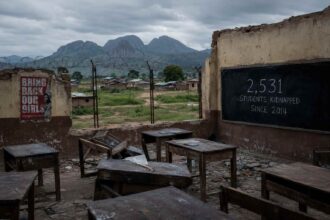


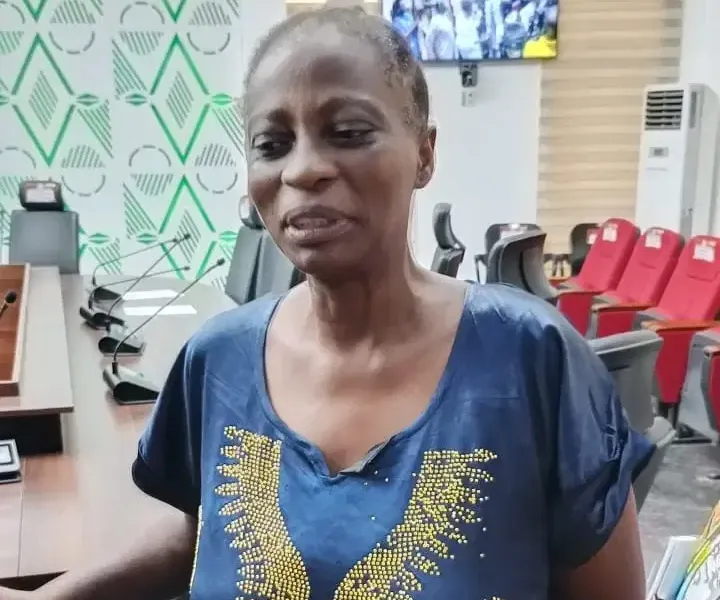
Oyo State – Mrs Rachael Alamu was not just a hostage during her 56 days in captivity. As principal of Community Grammar School in Ahoro Esinele, she became, without ever choosing to, the closest thing to a guardian that dozens of frightened schoolchildren had left.
She recounted her ordeal to journalists at the Oyo State Government House in Ibadan on Monday, four days after she and 43 other victims were formally handed over to state officials following their July 10 rescue. What she described was not a single act of violence, but a slow, grinding two months of forced movement, deprivation, and cruelty inflicted on children as young as toddlers.
The abductors, she said, relocated their captives constantly, always at night, whenever they suspected security forces had located their hideout. “There were times we had to move from one place to another. Once they believed the place had been discovered, we would start moving around 7:00 p.m.,” she said.
Related News
The physical toll of those nightly treks fell hardest on the youngest. “They carried the youngest three children. The secondary school girls carried some of the smaller pupils, while the others had to walk. We fell many times,” Mrs Alamu recalled, describing exhausted children stumbling through unfamiliar terrain in darkness, again and again, for weeks on end.
She described the abductors’ cruelty as calculated rather than random. Noise, she said, was treated as the greatest threat to the kidnappers’ concealment, and children were punished accordingly. “Some of the children were beaten. You know children; some are quiet, some are loud. What they hated most was noise because they believed it could attract attention,” she said.
Among the men held alongside her, she said, physical restraint became routine, a detail that speaks to how thoroughly the kidnappers had settled into treating their hostages as long term captives rather than a fleeting bargaining chip to be resolved quickly.
Related News
The rescue operation that finally ended the ordeal came at a heavy cost. Two teachers were killed during the initial abduction and subsequent captivity, including Michael Oyedokun, whose death was confirmed only after the kidnappers released a video that shocked the nation and intensified pressure on security agencies to act.
The operation that freed Mrs Alamu and the remaining victims involved a coordinated effort across the Nigerian Army, the Nigerian Air Force, the Nigeria Police Force, the Department of State Services, the Nigeria Security and Civil Defence Corps, the Amotekun Corps, and local hunters and vigilantes, security officials said, describing it as one of the most complex rescue operations undertaken in the South West in recent years.
Mrs Alamu’s account, delivered calmly and in careful detail, has become one of the fullest public records of what the Oriire captives endured. Security analysts say testimonies like hers are proving valuable beyond their emotional weight, offering investigators rare insight into how kidnapping networks operate, move, and sustain themselves inside forest terrain that has increasingly become a staging ground for mass abductions across the South West.
For Mrs Alamu, the accounting is not yet finished. She and the other survivors remain under medical observation, and the network responsible for holding them for nearly two months has been only partially dismantled. But for the first time in 56 days, she is telling her story from a government house in Ibadan, not a forest hideout, and that alone, she has made clear, is not something she takes lightly.