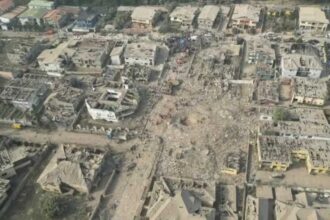



On May 15, 2026, gunmen wearing military uniforms stormed three schools, Baptist Nursery and Primary School in Yawota, Community Grammar School and L.A. Primary School in Esiele, in the Oriire Local Government Area of Oyo State. They killed at least one teacher and abducted dozens of pupils and staff, including the school principal, Mrs Rachael Alamu. More than a month later, as of Governor Seyi Makinde’s Newsletter No. 140 on June 12, the victims remained held within the Old Oyo National Park, 27 days into their ordeal at the time of that update. The Oyo State Police Command has had to repeatedly debunk false social media claims of their release, claims that briefly circulated with such force that even a Special Adviser to President Bola Tinubu shared one before it was retracted. Meanwhile, in Ogun State, security operatives have traced a separate rising wave of kidnappings to a Fulani settlement on the Ijebu-Ode/Ibadan Road axis. According to ACLED, the Africa-focused conflict data organisation, this represents a significant and concerning geographical shift, Oyo State, in Nigeria’s southwest, has not traditionally been associated with the large-scale kidnappings long endemic to the northeast and northwest.
Nigeria’s kidnapping crisis has stopped asking for permission to cross regional lines. It has simply crossed them.
For years, the southwest was spoken of, by politicians, by security analysts, even by ordinary citizens, as Nigeria’s relatively stable zone, a region where the worst of the nation’s insecurity was something that happened elsewhere, to other people, in other forests. That comfort has now been shattered. The Yawota and Esiele school attacks were not an isolated, freak occurrence. They followed the January 2026 killing of a police officer and abduction of a Chinese expatriate in a commando-style raid on a company in Ogunmakin, Oyo State. They followed a wave of attacks across Ondo, Osun and Ekiti, 32 reported incidents in just two months, according to regional reporting, that have left farmers afraid to tend their fields and travellers afraid to use major highways. The pattern is no longer deniable. The southwest has a security blind spot, and armed groups have found it.
Related News
It is worth being precise about what has actually failed here, because vague hand-wringing about “insecurity” lets everyone off the hook too easily. ACLED’s own data shows that Oyo State accounts for only around one percent of all political violence recorded in Nigeria this year, a share broadly consistent with previous years. The problem, then, is not that the southwest has suddenly become as violent as the northwest, where ACLED has already recorded over 400 kidnappings in 2026 alone. The problem is that a region built on the assumption of relative safety has discovered it has almost none of the institutional defences, the local vigilance networks, the rapid-response capability, the forest-combing expertise, that the northwest has been forced, brutally, to develop over a decade of bandit warfare. When violence is rare, complacency sets in. That complacency is now the soft underbelly being exploited.
This is precisely the danger that Dr Ladd Serwat, ACLED’s Senior Africa Analyst, has flagged: that the geographical shift represented by the Oyo abductions is “especially concerning” because the southwest has not traditionally been associated with mass abductions of this kind. We share that concern, and we believe it demands a response that goes beyond the reactive deployment of “anti-kidnapping squads” after the fact. A region cannot build security architecture in the days after an atrocity. It must build it in the months and years before one, and the southwest, by its own past comfort, has not.
We commend the steps that have been taken so far. The rescue of five kidnap victims on April 28, 2026, through what authorities described as sustained operational pressure, shows that Nigeria’s security agencies are not without capability when properly mobilised. Governor Makinde’s repeated, transparent updates, even when the news is that victims remain in captivity nearly a month on, stand in welcome contrast to the evasive denial we have too often documented from other state governments facing similar crises. The Nigeria Union of Teachers’ nationwide solidarity action, and the coordinated rallies across all 36 state capitals, demonstrate that civil society retains the capacity to mobilise national attention when government response feels too slow. These are not small things. But they are not, on their own, a solution.
Related News
- THE PRICE OF PARALYSIS: Why the Oyo Education Shutdown Exposes the Total Failure of Local Security
- THE ILLUSION OF GATEWAY SECURITY: Why Automated Customs Systems at Airports Cannot Stem the Flow of Illicit Cash
- THE SUPERFICIAL SHIELD: Why Airport Thermal Scanners Will Not Save Nigeria from the New Ebola Threat
What is troubling is the pace. Twenty-seven days, by the governor’s own account, with credible leads being pursued and “every lawful measure” deployed, and the victims remain in the forest. We do not minimise the genuine operational difficulty of extracting hostages from terrain as dense as the Old Oyo National Park without endangering their lives. Hostage rescue is delicate, and impatience from outside observers can itself become a danger if it pressures security forces into premature action. But nearly a month of captivity for children abducted from a primary school classroom is not a timeline that any government should accept as the new normal, in the southwest, the northwest, or anywhere else in this country.
The deeper failure, however, is structural, and it predates this particular abduction by years. The Western Nigeria Security Network, Amotekun was established precisely to give the six southwest states a coordinated, region-wide response to exactly this category of threat: herder-farmer conflict, cross-border banditry, and organised criminal incursion into rural communities. Its mandate exists. Its visibility, in this crisis, has not matched that mandate. If Amotekun is not equipped, funded, or deployed with the urgency this moment demands, southwest governors owe their citizens an honest account of why, and a credible plan to change it, not in the next budget cycle, but now.
We therefore call on the following. First, the six southwest governors must convene an emergency joint security summit, not a routine council meeting, but a dedicated session focused exclusively on closing the operational gaps that allowed armed men in military uniform to walk into three schools undetected and walk out with dozens of children. Second, Amotekun must be reviewed, re-resourced and integrated more tightly with federal security agencies’ intelligence-sharing systems, so that the region is not perpetually relearning lessons the north has already paid for in blood. Third, the Federal Government must treat the Oyo abduction with the same urgency and visibility it has, rightly, given to Northwest banditry; a kidnapped child’s life is not worth less because of which side of the Niger they live on. Fourth, schools in vulnerable rural local government areas across the southwest must receive an emergency security audit, with concrete protective measures, not press statements, implemented before the new academic term begins.
The forests of Oyo, Ogun, Ondo, Osun and Ekiti were never empty of risk; they were simply, for a time, empty of this particular risk. That window has now closed. Nigeria does not have the luxury of regional complacency anymore, not when armed men can disguise themselves as soldiers, walk into a primary school, and disappear into a national park with the nation’s children for nearly a month without a rescue.
The southwest’s children are still in that forest. So is the country’s claim to be making progress on security. Neither should be left there a day longer than necessary.