

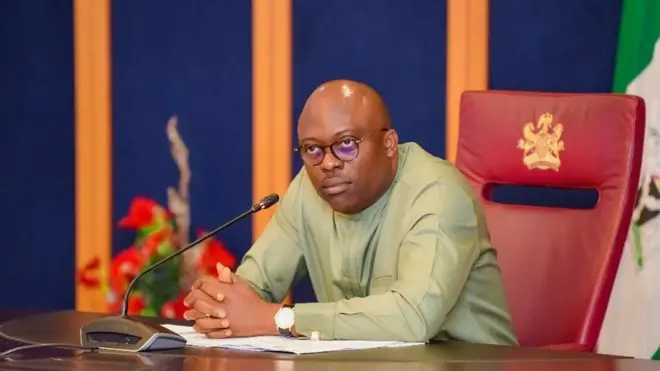
LAGOS — Two political stories from the last year offer stark lessons about the dangers of misplaced loyalty in Nigerian politics. Punch Newspapers published an in-depth analysis on Wednesday examining the political experiences of Rivers State Governor Siminalayi Fubara and actor-lawmaker Desmond Elliot, describing them as cautionary tales for anyone navigating Nigeria’s treacherous political terrain.
Governor Fubara rose to power in Rivers State in 2023 as the chosen successor of his political godfather, former Governor Nyesom Wike. He won the governorship election with Wike’s full backing. However, the relationship between the two men collapsed spectacularly within months of Fubara taking office, leading to one of the most dramatic political crises in Rivers State history.
The Fubara-Wike conflict consumed Rivers State politics for most of 2024 and 2025. It involved the near-demolition of the Rivers State House of Assembly by loyalist lawmakers, multiple court battles, federal government interventions, and ultimately a declaration of a state of emergency in Rivers State. Fubara paid an enormous political price for a relationship he had trusted completely.
Related News
Desmond Elliot’s story, while less dramatic, carries similar lessons. The actor-turned-lawmaker revealed recently that he voted for the impeachment of Lagos House of Assembly Speaker Mudashiru Obasa in January 2025 because he was told the move had presidential backing. That information proved incorrect, and Elliot found himself on the wrong side of a political battle he had entered in good faith.
The Cost of Misplaced Trust
Both stories illustrate a fundamental reality of Nigerian politics: information is often weaponised, loyalties are rarely permanent, and those who act on secondhand political intelligence do so at their own risk. Fubara trusted Wike completely until the relationship collapsed. Elliot trusted Gbajabiamila’s information without independently verifying it.
Related News
Political analyst Ike Abonyi said both men made the same mistake in different ways. He said in Nigerian politics, you must always verify political information from multiple sources before acting on it. You must also understand that godfathers have interests that may not align permanently with the interests of their political sons and daughters.
Furthermore, both Fubara and Elliot have survived their political crises and remain active in public life. Fubara has managed to stabilise his governorship despite the conflict with Wike. Elliot continues to serve his constituency and is exploring his political options ahead of 2027. Their resilience is itself instructive.
Lessons for 2027
The Punch analysis specifically connects both stories to the broader lessons relevant for the 2027 election season. Multiple political actors are currently making decisions about party allegiances, coalition partnerships, and primary participation based on verbal assurances and informal political intelligence.
Those who act on such information without deeper verification or independent judgment risk repeating the Fubara and Elliot experiences. The ADC primary crisis, where aspirants trusted the party’s promises about a credible process, is perhaps the most immediate example of this dynamic playing out in the current political season.
Political observers said Nigeria needs institutional reforms that reduce the role of individual political patrons and make party processes more rule-based and predictable. Until those reforms are in place, however, every Nigerian politician must develop the instinct to verify, triangulate, and protect their own interests before acting on political information that comes through informal channels.