


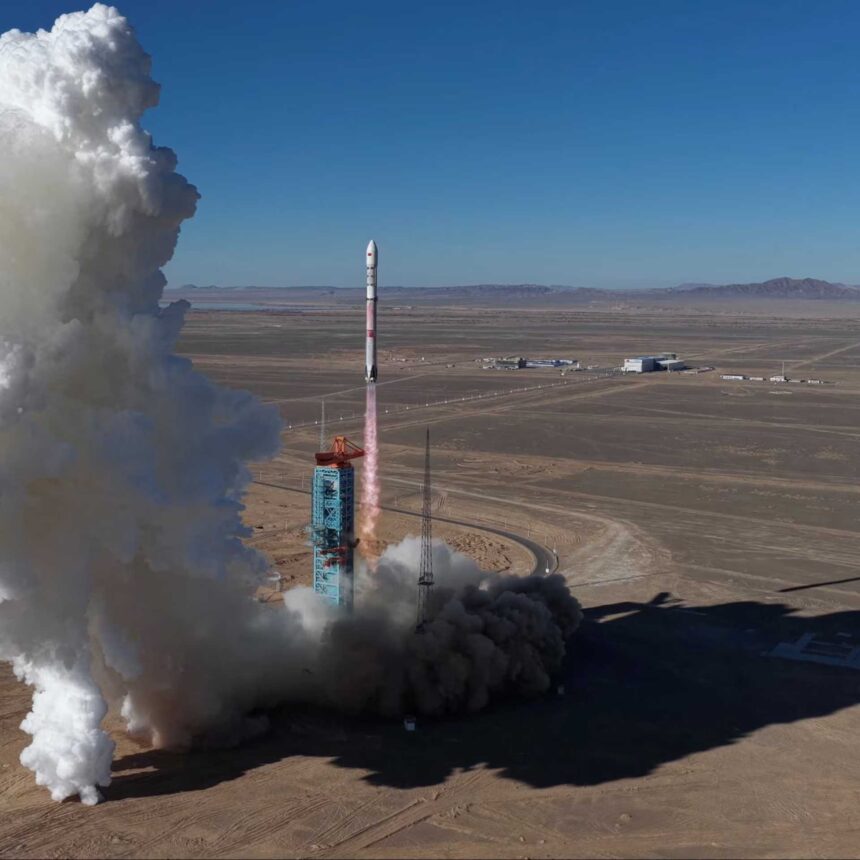
A Chinese commercial rocket exploded shortly after take-off on Saturday, raising fresh questions about Beijing’s push to compete with private space companies such as SpaceX.
The incident occurred at the Jiuquan Satellite Launch Center in northwest China, where the Tianlong-3 rocket, developed by private firm Space Pioneer, was undergoing its first test flight. The rocket lifted off successfully but malfunctioned within seconds, resulting in its destruction.
Authorities confirmed that no casualties were recorded, as the launch site had been cleared ahead of the test. Debris reportedly fell in designated safety zones, preventing wider damage.
Related News
The Tianlong-3 was designed as a heavy-lift rocket capable of carrying payloads comparable to SpaceX’s Falcon 9. Its failure highlights the challenges China faces as it seeks to expand its commercial space industry and reduce reliance on state-backed missions.
Space Pioneer, officially known as Beijing Tianbing Technology Co., had earlier announced that the Tianlong-3 would be a reusable rocket, aiming to cut costs and improve efficiency. The company had positioned the launch as a milestone in China’s bid to match the rapid progress of Elon Musk’s SpaceX, which has dominated the global commercial launch market.
In a statement after the incident, Space Pioneer said engineers were investigating the cause of the failure. “We will carefully analyze the technical issues and continue to improve the rocket’s design,” the company noted.
Related News
China has invested heavily in its space programme, with both government and private firms racing to develop reusable rockets. The country has already achieved significant milestones, including crewed missions to its Tiangong space station and lunar exploration projects. However, Saturday’s setback underscores the difficulties of competing with established players like SpaceX, which has conducted hundreds of successful launches and perfected reusable rocket technology.
Analysts say the failure is unlikely to derail China’s long-term ambitions but may slow private-sector efforts. “This is part of the learning curve,” said a Beijing-based aerospace expert. “SpaceX also faced multiple failures before achieving reliability. China’s private firms will need time and resources to catch up.”
The Chinese government has encouraged private companies to enter the space industry in recent years, hoping to foster innovation and reduce costs. Dozens of start-ups have emerged, focusing on satellite launches, reusable rockets, and space-based services.
Despite the setback, Space Pioneer remains one of the most promising firms in the sector. Earlier this year, it became the first Chinese private company to launch a liquid-fuel rocket into orbit, marking a breakthrough in commercial spaceflight.
For now, the Tianlong-3 failure serves as a reminder of the risks involved in space exploration and the steep competition in the global launch market. As Beijing continues to push forward, the race with SpaceX and other international players is expected to intensify.