

He was 34 years old. He worked a desk job in Lagos. He ate suya most evenings, drank on weekends, and had not been to a hospital since his NYSC medical. One Tuesday morning, he collapsed at his office and never came back. His family was told it was a stroke. His wife later found out his blood pressure had been dangerously high, possibly for years. He had never felt sick a day in his life.
This is not a rare story in Nigeria. It plays out in offices, homes, and markets every single week. High blood pressure — what doctors call hypertension — is the leading cause of stroke and sudden death in this country. And most of the people carrying it have no idea.
This piece is for every Nigerian who has never checked their blood pressure, thinks hypertension only affects older people, or keeps putting off that clinic visit. The numbers tell a clear story. The lifestyle connection is plain. And the good news is that a lot of what protects you costs nothing at all.
Related News
One in Three Nigerian Adults. Most Don’t Know.
Start with the numbers, because they are striking.
Between 30 and 40 percent of Nigerian adults have high blood pressure. That is roughly one in every three people. In a country of over 220 million, the researchers estimate somewhere between 27 and 32 million Nigerians are living with this condition right now. Some studies put the figure even higher, with community screenings in markets and workplaces finding rates as high as 42 percent among those tested.
Related News
But here is the part that really matters. Of all the Nigerians with high blood pressure, only about 29 percent know they have it. Just 12 percent are on any form of treatment. And only around 3 percent have their blood pressure properly under control.
Read those numbers again slowly. Fewer than one in three people with the condition have been told about it. Fewer than one in ten are treating it. And of those treating it, fewer than one in three are actually managing it well.
This is not a matter of people ignoring their doctors. Most of these people have simply never been told. High blood pressure produces no pain, no fever, no visible sign. You can walk around with dangerously elevated blood pressure for years and feel completely fine. By the time a symptom appears — a blinding headache, chest pain, or sudden weakness on one side of the body — serious damage may already be done.
It Is Not Just an Old Person’s Disease Anymore
For a long time, Nigerians thought of high blood pressure as something that came with old age. Your uncle in his sixties, your grandmother who took those small white tablets every morning. Something that happened to people who had lived long enough.
That picture has changed, and doctors are worried about it.
Cardiologists at the University College Hospital in Ibadan and at the National Hospital in Abuja both flagged the same trend in May 2026, speaking ahead of World Hypertension Day: hypertension is rising sharply among Nigerians under 40. One consultant cardiologist said plainly: “We are seeing increased cases of hypertension in people as young as 30.”
A study across three Nigerian states — Abia, Oyo, and Kano — looked at 924 young adults between 18 and 40 years of age. It found hypertension prevalence as high as 21.3 percent in some areas within that group. These are not middle-aged people. Many are finishing university, starting their first jobs, or raising small children.
What is driving this in young Nigerians? Doctors point to the same handful of things every time: unhealthy eating habits, a life that involves very little physical movement, too much alcohol, chronic stress, and a family history that was never taken seriously because “we are young, it won’t happen to us.”
The 2023–2024 Nigeria Demographic and Health Survey found that only about half of women and just one-third of men aged 15 to 49 had ever checked their blood pressure. Among those who had checked, only 8 percent of women and 5 percent of men had ever been told by a health worker that they were hypertensive. Five percent. In a country where the real prevalence is 30 to 40 percent.
The gap between who has it and who knows they have it is enormous. And it is in that gap that strokes happen.
What High Blood Pressure Is Actually Doing to Your Body
Think of your blood vessels as pipes. When water pressure in a pipe is too high for too long, the pipe walls weaken, cracks form, and eventually something bursts or blocks completely. Your arteries work the same way.
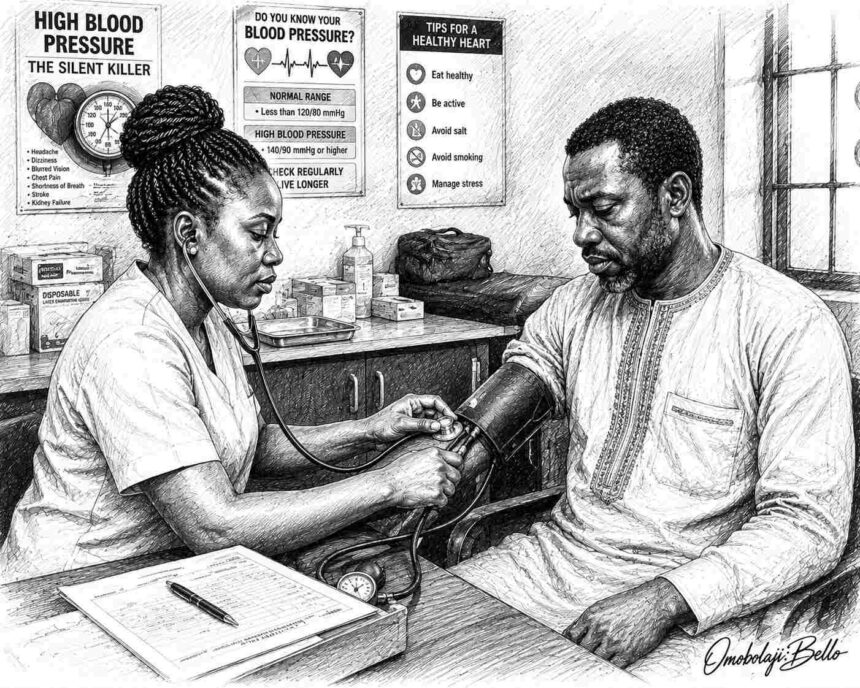
Blood pressure is measured with two numbers. The first number — systolic — is the pressure when your heart beats and pushes blood out. The second — diastolic — is the pressure between beats. A normal reading sits around 120 over 80. Hypertension is generally defined as 140 over 90 or higher, though the newest international guidelines from 2025 now recommend a target of below 130 over 80 for people being treated.
When pressure stays too high for too long, the damage builds quietly. The heart works harder than it should, and over time it thickens and weakens. The blood vessels in the brain face enormous pressure with every heartbeat, and a single rupture or blockage causes a stroke. The kidneys, which filter blood constantly, slowly lose function under sustained high pressure. The eyes, the heart valves, the arteries in the legs — all of these get hit.
This is why high blood pressure is called a silent killer. It does not feel like anything while it is doing all of this. A person can have blood pressure at 180 over 110 and feel fine enough to go to work, play football with their children, and eat dinner. The damage is happening inside, invisible, without a single warning.
In Nigeria, hypertension is the most common cause of cardiovascular and cerebrovascular disease. It is the most common cause of sudden unexpected death. About 25 percent of adult hospital admissions in this country are for complications caused by uncontrolled high blood pressure. The WHO estimates that globally, more than 1,000 lives are lost every single hour to strokes and heart attacks driven by high blood pressure. Most of those deaths were preventable.
What Is Putting Nigerian Blood Pressure Up
You cannot separate Nigeria’s hypertension crisis from the way many Nigerians live today. The risk factors are not mysterious. They are daily habits, many of them normalised to the point where nobody questions them.
Salt is the big one. Nigeria’s diet is heavily salted at multiple stages: during cooking, through seasoning cubes, through processed snacks, and through fast foods eaten at roadside stalls and canteens. The WHO recommends less than 5 grams of salt per day. Research consistently finds Nigerian diets are far above that level. And the consequences are measurable: high salt intake raises blood pressure directly by causing the body to retain water, which increases the volume of blood pressing against artery walls.
Physical inactivity is the second major driver. Many working Nigerians spend long hours seated — in offices, in traffic, behind counters. The body was not designed for this. The heart and blood vessels stay healthier when the body moves regularly, because exercise strengthens the heart and makes arteries more flexible. Yet only about 20 percent of hypertensive Nigerians in some studies reported doing any regular exercise.
Alcohol is more directly linked to high blood pressure than most people realise. A large systematic review of Nigerian and West African dietary data confirmed that high alcohol consumption significantly raises the risk of hypertension. Alcohol causes the body to release hormones that tighten blood vessels and raise pressure over time. For people who already have hypertension, regular drinking makes control nearly impossible.
Stress deserves its own mention. The financial pressure of living in Nigeria today — rising food prices, fuel costs, school fees, job insecurity — creates a kind of low-grade, constant stress that the body reads as danger. When the body senses danger, it releases adrenaline and cortisol. These hormones tighten blood vessels and raise blood pressure. In the short term, this is a survival response. Sustained for months and years without relief, it becomes a health crisis.
Obesity ties all of these threads together. Excess body weight makes the heart work harder, raises inflammation, and disrupts the hormones that regulate blood pressure. The rising rates of overweight and obesity in Nigerian cities — driven by more processed food, less movement, and more sedentary work — are contributing directly to the hypertension surge the cardiologists are warning about.
The Drug Cost Problem Nobody Is Talking About Loudly Enough
Here is a thing that does not get said enough in conversations about hypertension in Nigeria: even when people find out they have it, many cannot afford to stay on the treatment.
High blood pressure is a lifelong condition. The drugs do not cure it. They manage it. The moment a person stops taking their medication, the pressure rises again. This means a patient who is diagnosed at 40 may need to buy drugs every single month for the rest of their life.
Research from Southwest Nigeria found that over half of rural hypertensive patients were spending more than 10 percent of their household income on blood pressure medication alone. A separate study in Ebonyi State found that 100 percent of the hypertensive patients surveyed said they could not afford their drugs. Every single one of them.
The Nigerian Hypertension Society made this public just weeks ago, in June 2026. Its president issued a direct appeal to the Federal Government and NHIA, warning that the high cost of antihypertensive drugs is making it impossible for many Nigerians to manage the condition. The society called it a crisis. They are right.
NHIA coverage is improving slowly, but it still reaches only a fraction of the people who need it. The informal sector worker, the market trader, the domestic help, the freelancer — these are the people most likely to be uninsured and most likely to stop treatment when the money runs out.
This is why lifestyle changes are not just a nice idea for Nigerian hypertension patients. For millions of people, lifestyle is the most accessible form of treatment available. Getting the salt down, moving the body, reducing alcohol, managing stress — these are not alternatives to medication for people already diagnosed. They work alongside medication. But for people at risk who are not yet hypertensive, they may be the difference between getting there and not.
What You Can Do — Starting Today, Without Spending Money
None of the steps below need a pharmacy or a hospital visit to start. They need a decision.
Check your blood pressure. This week. Not next month. Not after the next public holiday. This week. Most pharmacies in Nigerian cities will check it for free or for a very small fee. Primary health centres offer it too. A blood pressure machine at a pharmacy takes less than two minutes. You cannot manage what you do not know.
Cut the salt down, starting with the cooking pot. The single most effective dietary change for blood pressure is reducing salt. Use less seasoning cube. Add less salt during cooking. Reduce the amount of processed and packaged snacks, which are usually very high in sodium. You do not have to eliminate salt entirely — just bring it down consistently. Small reductions over weeks add up.
Move your body for 30 minutes, five days a week. It does not need to be a gym. Walking counts. A brisk walk around your neighbourhood in the early morning or evening, consistently, is enough to make a real difference to blood pressure over time. The research recommendation is at least 150 minutes of moderate activity a week. That is 30 minutes, five days. No equipment, no membership, no money.
Cut back on alcohol, especially if your pressure is already elevated. If you have been told your blood pressure is high, alcohol is working directly against your treatment. Reducing intake — or stopping entirely for a period — is one of the fastest lifestyle changes that shows up in blood pressure readings. This is not about being extreme. It is about being honest with yourself about what the body is dealing with.
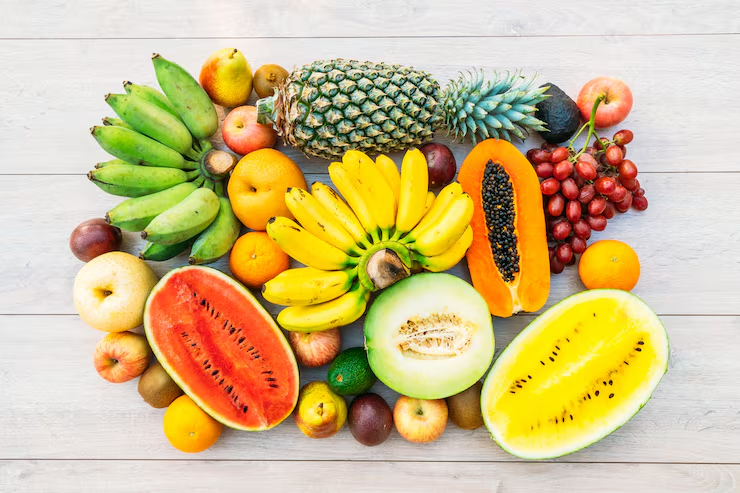
Eat more of the local foods that actually protect the heart. Fruits and vegetables are among the most powerful blood pressure protectors the research has found, and Nigeria grows plenty of them. Garden egg, ugu, waterleaf, tomatoes, pawpaw, banana, garden eggs, and leafy greens are all affordable, local, and genuinely useful. Replacing one processed snack a day with fresh fruit is a start. It does not have to be a dramatic overhaul.
Know your family history and take it seriously. If a parent, sibling, or grandparent had hypertension, stroke, or heart disease, your risk is meaningfully higher than someone with no family history. This is not a reason to panic. It is a reason to check your blood pressure regularly and watch the lifestyle factors more carefully. Family history is not destiny. But it is useful information.
If you are already on medication, stay on it. The most dangerous thing a hypertensive Nigerian can do is start drugs and then stop because they feel fine. The reason they feel fine is often because the medication is working. Stopping it puts the pressure straight back up, often higher than before, and dramatically increases the risk of stroke. If the cost of drugs is a problem, speak to your doctor about the cheapest effective option, check your NHIA eligibility, or ask at a primary health centre about available programmes.
The Bigger Picture: A Disease Nigeria Can Actually Fight
Hypertension is unusual among serious health conditions in one important way: it responds very well to things people can do for themselves, without waiting for government policy or healthcare system reform.
That is not an excuse for the system to stay broken. The NHIA coverage gap is real. The drug affordability crisis is real. The shortage of functioning blood pressure machines in many rural primary health centres is real. These are failures of policy and investment that need to be fixed, and the Nigerian Hypertension Society is right to push loudly for them.
But while those battles are fought, individuals can act. And the actions available are genuinely powerful. Researchers who have studied hypertension control in Nigerian communities consistently find that awareness alone moves the needle. People who know their BP numbers are dramatically more likely to do something about them. People who understand what the condition actually does to the body are more likely to stay on treatment.
The theme for World Hypertension Day 2026 was: “Controlling Hypertension Together: check your blood pressure regularly, defeat the silent killer.” It is a good summary. The “together” part matters — family members reminding each other, neighbours pointing toward free screening days, workplaces putting a blood pressure machine in the sick bay. None of this is complicated.
What is complicated is the reality that millions of Nigerians right now are walking around with blood pressure high enough to cause a stroke, feeling nothing, suspecting nothing, and waiting for a symptom that may never come before the damage is done.
The story at the top of this piece does not have to keep happening. That is the whole point of writing it.
Know Your Numbers: Where to Check
Free or low-cost blood pressure checks are available at most of these locations:
- Any primary health centre (PHC) in your local government area
- Licensed Community pharmacies — most will check for free or a small fee
- Hospital outpatient departments during routine visits
- NHIA-registered health facilities (check eligibility at nhia.gov.ng)
- Nigerian Hypertension Society outreach events — follow their announcements at nigerianhypertensionsociety.org
This article is for general information only. It is not a replacement for professional medical advice, diagnosis, or treatment. If you have been diagnosed with hypertension, speak with a qualified health professional before making changes to your medication.