

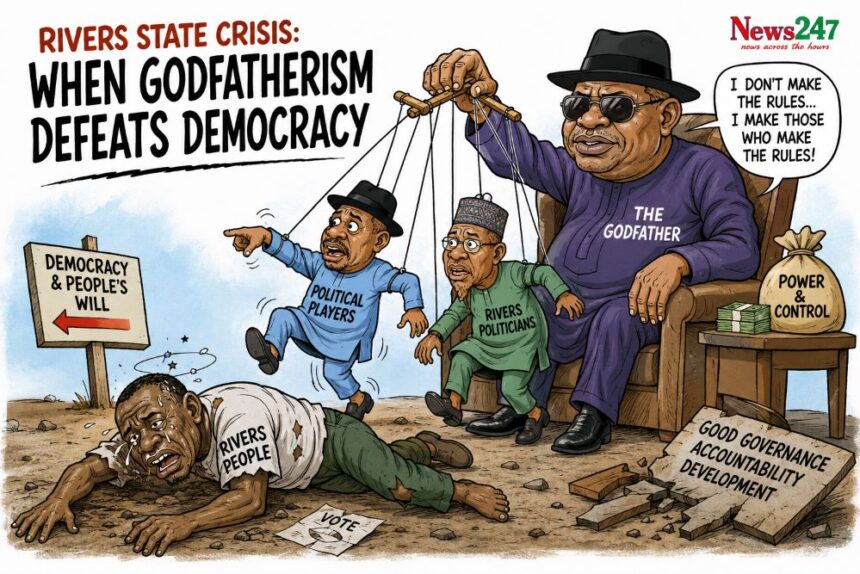
The facts of the Rivers State crisis have never been in serious dispute. In May 2026, an APC screening committee for the 2027 Rivers State House of Assembly elections disqualified all 32 aspirants backed by Governor Siminalayi Fubara, while clearing all 27 sitting lawmakers loyal to FCT Minister Nyesom Wike. Out of nearly 100 hopefuls who participated in the two-day exercise in Port Harcourt, only 33 candidates made the cut — a list overwhelmingly composed of incumbents aligned with the former governor. Governor Fubara’s most prominent allies, including former Speaker Victor Oko-Jumbo, Sokari Goodboy, and Timothy Orubibanugha, were each disqualified on technical grounds ranging from missing permanent voter cards to irregularities in nomination affidavits. The committee, for its part, maintained that the exercise was conducted in full compliance with the APC constitution. Wike, now publicly claiming he is not even a member of the APC, says the matter is entirely outside his purview. Few Nigerians — and certainly none in Rivers State — believe him.
This is not merely a quarrel between two powerful men. It is a symptom of a disease that is eating the foundations of Nigeria’s democratic governance.
The Fubara-Wike conflict did not begin in 2026. It erupted almost immediately after Governor Fubara’s inauguration in May 2023 — when it became clear that the new governor, once the anointed successor of his political godfather, intended to govern with independent judgment rather than as a proxy. What followed was one of the most sustained and destructive political sieges a sitting governor has faced in Nigeria’s Fourth Republic. The Rivers State House of Assembly — then dominated by Wike loyalists — launched serial impeachment proceedings against Fubara. Allocations from the federal government were withheld after a Supreme Court ruling tied disbursements to a budget presentation before the Wike-aligned legislative faction. Fubara eventually defected from the PDP to the APC in late 2025, a move widely interpreted as a calculated attempt to ease the pressure and find shelter within the ruling party. It has not worked. The APC structure in Rivers, it turns out, is as deeply colonised by Wike’s influence as the House of Assembly he left behind.
Related News
What makes the current phase particularly alarming is what it reveals about the condition of Nigeria’s political parties. The APC’s screening exercise in Rivers was not a party process — it was a factional operation dressed in party clothing. When a screening committee produces a list that perfectly mirrors the preference of one powerful individual, disqualifying his rival’s entire slate on the basis of technicalities that, in previous election cycles, would have been treated as correctable errors, the integrity of the process has collapsed. As political analyst Sam Amadi observed, “Sad. Fubara should have known he had no leverage. What his opponent does in the political economy of election rigging he cannot do.” That a respected commentator would describe what happened in Rivers as “election rigging” without fear of legal challenge is itself a measure of how normalised political manipulation has become in our democracy.
There is a governance cost to all of this that receives insufficient attention. The Rivers State House of Assembly has not sat for an extended period. Commissioner nominees submitted by the governor have been rejected. The state’s budget has become a political football, with the Supreme Court wading into what should be a routine legislative exercise. In a state that contributes significantly to Nigeria’s oil revenue, that hosts one of Africa’s largest port complexes, and that has the infrastructure and human capital to be a regional economic powerhouse, governance has been held hostage by the ambitions of men who will not share power and will not accept electoral outcomes they did not personally engineer. The people of Rivers State — the traders in Port Harcourt markets, the fishermen in the riverine communities, the students in public universities — did not vote for a proxy war. They voted for governance. They have received a spectacle instead.
We note with concern that President Bola Tinubu, who brokered a peace accord between Fubara and Wike in 2024, has allowed that accord to unravel without decisive intervention. The terms of that accord — that Fubara would join the APC and not seek re-election — have become the very weapons being used against him. One of the conditions of a peace deal cannot be the permanent subordination of a sitting governor to the will of his predecessor. That is not peace. That is surrender on an instalment plan. The presidency must decide whether it stands for the principle that sitting governors are entitled to exercise the constitutional authority vested in them by the electorate — or whether Rivers State is a special case where godfatherism supersedes democracy. There is no neutral position available. Silence, in this context, is a choice — and it is a choice with consequences.
Related News
- THE ILLUSION OF MARKET RECOVERY: Why Paper Appreciation of the Naira Cannot Cure Underlying Structural Liquidity Defects
- THE PRICE OF PARALYSIS: Why the Oyo Education Shutdown Exposes the Total Failure of Local Security
- THE ILLUSION OF GATEWAY SECURITY: Why Automated Customs Systems at Airports Cannot Stem the Flow of Illicit Cash
The 2027 elections are now less than two years away. Rivers State is already a theatre of political warfare, and the conflict will intensify as the governorship race takes shape. The danger is not merely that one faction will defeat another. The danger is that the methods being deployed — party machinery weaponised for factional ends, technical disqualifications as political tools, legislative paralysis as a governing strategy — will become the national template. What Rivers normalises today, other states will replicate tomorrow. Nigeria’s democracy is young enough that bad precedents still have the power to define trajectories.
We therefore call on the Independent National Electoral Commission to place Rivers State under enhanced monitoring for the 2027 electoral cycle and to scrutinise all party primaries in the state for compliance with the Electoral Act. We call on the APC national leadership to review the Rivers screening report transparently, and to either justify the disqualifications on genuine merit or order a fresh exercise conducted under independent supervision. We call on the National Assembly to investigate the sustained legislative paralysis in Rivers State and its impact on governance and public service delivery. We call on the judiciary to continue its role as the last line of constitutional defence — and to do so without fear or favour, as it has on occasion done before. And we call on President Tinubu to recognise that allowing this crisis to fester is not political neutrality — it is an abdication of the responsibility he accepted when he swore to uphold Nigeria’s constitution.
Godfatherism is not a Rivers State problem. It is a Nigerian problem that Rivers State is currently making visible. The question before the nation is whether democracy in Nigeria means the right of citizens to elect their leaders — or the right of powerful men to determine, regardless of what citizens decide, who actually governs.
Rivers State is watching. So is the rest of Nigeria. And history is taking notes.