

My Thoughts Have No Filter By Abdul’Azeez Bello
0805 113 0075 (WhatsApp) | omobolajibello@gmail
Related News
God Is Not on the Budget. But He Is on Every Excuse.
Let me say something that will make some of you grip your Bible tighter and others reach for their tasbih.
Nigeria is one of the most religious countries on the face of this earth. Over 99 percent of Nigerians identify with a religion. Nearly half are Muslim. Nearly half are Christian. The remaining fraction follow traditional religions, which honestly at this point might be the most honest option because at least they are not pretending that prayer alone fixes roads.
According to Pew Research Center data cited by the Nigerian Presidency itself, over 99 percent of Nigerians identify with a religion. We have churches on every street. We have mosques on every corner. In some parts of Lagos, different floors of the same building belong to different denominations, each one competing to be louder than the one below.
Related News
And yet. According to the World Bank’s most recent data, 30.9 percent of Nigerians live below the international extreme poverty line.
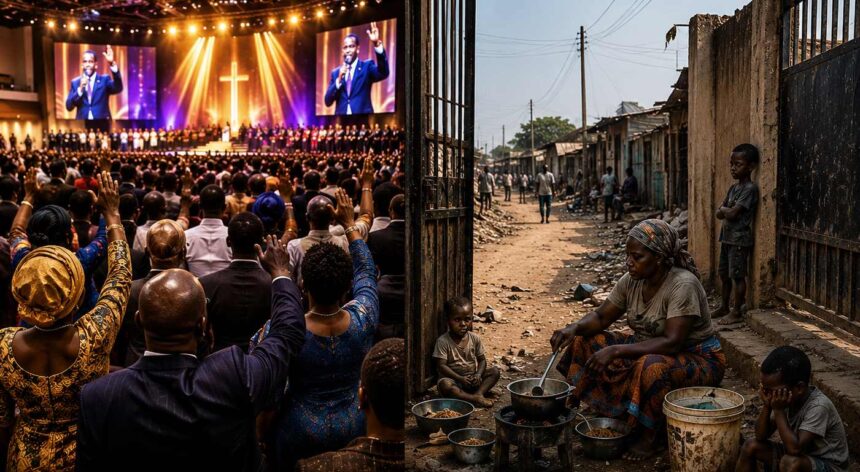
Let me repeat that. Nigeria is 99 percent religious and nearly a third of its people cannot meet basic daily needs.
If prayer was an economic policy, Nigeria would be the wealthiest nation on earth. It is not. And yet we keep acting like it is.
The Church Has Entered the Chat. So Has the Mosque. Neither Is Fixing Anything.
I grew up in Nigeria. I know what Sunday morning sounds like. I know what Jumu’ah Friday feels like. I know the energy. The music. The declarations. The prophet who just received a word from God that this year is your year of financial breakthrough.
Your year of financial breakthrough has been arriving annually since 1999-99. It has not landed yet. But the offering basket has. Consistently.
Two years ago, a renowned pastor sparked controversy when he suggested that Nigeria’s issues are more spiritual than political, requiring divine intervention. His statement faced significant backlash on social media, with critics arguing that the solution to Nigeria’s problems lies in practical governance, not spirituality.
With the greatest of respect to him, I need someone to explain to me how a spiritual problem produces a very physical pothole on the Abuja Kano expressway. I need someone to explain how demonic forces specifically targeted the power grid and left South Korea untouched. I need someone to explain why God’s intervention seems to arrive more reliably in Switzerland than in Sokoto.
Meanwhile renown prophet made headlines by controversially attributing the depreciation of Nigeria’s currency to his own absence, a statement that attracted widespread ridicule.
The naira fell because a prophet travelled. Write that down. Frame it. Put it next to your economics degree and weep quietly.
Faith as Escape Route: The Mechanics of Spiritual Denial
Here is how the religion trap works in Nigeria and it works on both sides of the mosque and church divide.
Something goes wrong. The government fails to deliver electricity, security, education, healthcare or basic infrastructure. Instead of rage, instead of organised demand for accountability, Nigerians retreat into spiritual explanation. It is the work of the enemy. It is a test from God. It is punishment for collective sin. Dry fasting has been announced. A prayer walk is scheduled. A seven day prophetic programme has been organised.
And the politician breathes a sigh of relief.
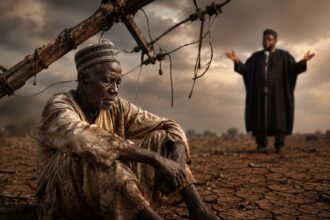
Because a citizen on their peeled knees is a citizen not pulling down the gates. A congregation waiting for divine intervention is a constituency that will not riot nor burn tires. A people who believe their suffering is spiritual will not demand that it be solved politically.
Academic researchers have noted that some Churches in Nigeria have deviated from the ultimate goal of Christianity and instead manipulate members to obtain funds, while poverty and economic inequality have made many people desperate for solutions to their financial problems, making them vulnerable to false prophets.
The desperation is real. The exploitation of that desperation is a choice.
The Prosperity Gospel’s Audacity Is Almost Beautiful
I want to take a moment to fully appreciate the genius of the prosperity gospel in the Nigerian context. Truly. It is a masterpiece of circular logic.
You are poor because you lack faith. Give more to demonstrate your faith. If the blessing does not come, you did not give enough or believe hard enough. Give more. Believe harder. Meanwhile the pastor’s private jet needs maintenance.
Another renown pastor faced allegations of financial misconduct and criticism for his prosperity gospel teachings, yet his ministry continued to grow maintaining a loyal global audience.
A popular apostle was embroiled in scandals involving accusations of financial exploitation and extramarital affairs, reigniting debates about pastoral accountability and ethics in religious leadership.
And yet the pews remain full. The donations keep flowing. The testimony night is packed.
I am not mocking faith. I am mocking the weaponisation of faith. There is a difference and it is important.
True religion, whether Islam or Christianity or anything else, has historically moved people toward justice, toward action, toward demanding dignity. What we have in too many Nigerian religious spaces today is the opposite. It is religion as sedative. Religion as distraction. Religion as management tool for a population that should be far angrier than it is.
The Imams Are Not Exempt From This Conversation
Before the Muslim community settles back comfortably while I talk about pastors and jet fuel, let me also knock on the mosque door.
The use of religious sentiment to suppress political accountability is not a Christian problem. It is a Nigerian problem that crosses every faith line.
In the north, religious leaders have enormous influence over communities that desperately need structural change, better schools, better healthcare, better security, better economic opportunity. Too often that influence is used to preach patience, to reinforce existing power structures, to discourage questioning of political authorities on grounds that challenging leadership is un-Islamic.
Poverty in Nigeria is severe and persistent. The rise of radical religious movements has been attributed partly to poor socioeconomic infrastructure and poor governance, with poverty seen as the major catalyst leading to the rapid increase in membership of religious extremist groups.
Religion did not cause that poverty. But religion, wielded carefully by those who benefit from keeping the poor in line, has helped to sustain it.
What True Faith Should Actually Look Like
I want to be clear about something before we get to the way forward.
I am not here to tell anyone to abandon their faith. I am here to challenge what that faith is being used for.
The Prophet Muhammad, peace be upon him, spoke directly and repeatedly about justice for the poor, accountability of rulers and the obligation to speak truth to power. The Bible, from the prophets of the Old Testament to the radical ministry of Jesus Christ, is soaked in demands for justice, for feeding the hungry, for challenging corrupt authorities.
Nigeria’s religious leaders have one of the most powerful platforms on earth. Millions of people listen to them every single week with genuine trust and open hearts. What is done with that platform matters enormously.
The Way Forward
Nigeria’s relationship with religion does not need to be broken. It needs to be redirected.
Religious leaders must preach accountability alongside anointing.
The same energy that fills a stadium for a miracle crusade must be directed at demanding that government hospitals have drugs, that public schools have teachers and that contracts for roads are actually executed. A congregation mobilised for justice is more powerful than any prayer line.
Separate spiritual matters from political failures.
The lights going off is not a spiritual attack. It is a procurement failure, a regulatory failure and a governance failure. Naming it correctly is the first step to fixing it. Pastors and imams who tell their congregations otherwise are not shepherds. They are gatekeepers for the status quo, if you know what I mean.
Hold religious institutions financially accountable.
Nigeria needs a proper framework for the financial reporting of religious organisations that collect significant public funds. Churches and Mosques that operate as businesses must be regulated as businesses. The faith of the congregation should not be a blank cheque for leadership to cash quietly without remorse.
Use religious networks for civic education.
No institution in Nigeria has more grassroots reach than the Church and the Mosque. Voter education, rights awareness, health information and civic engagement can flow through these networks if leaders choose to make them flow. The infrastructure exists. The will is what is missing.
Citizens must separate faith from political judgment.
Voting for a candidate because they share your religion while ignoring their record is not faith. It is tribalism wearing a prayer cap. Nigeria has tried religious solidarity as a political strategy for decades. The results are in the poverty statistics.
The Verdict
Nigeria is not suffering because God has abandoned it. Nigeria is suffering because the people who run it have abandoned their responsibilities while its citizens have too often outsourced their outrage to the spiritual realm.
Faith is not the enemy. Blind faith weaponised by the powerful to silence the powerless is the enemy.
The same God that Nigerians cry to every Sunday and bow to every Friday gave them minds, gave them voices, gave them the ability to organise and demand better. Using those gifts is not a lack of faith. It is faith in action.
Nigeria does not need another prayer mountain. It needs citizens who pray and then stand up, walk out of the church, walk out of the mosque, and demand that this country works for everyone who lives in it.
The altar is important. The ballot box is equally sacred. The street where your neighbour is hungry is holy ground too.
God helps those who help themselves. And in Nigeria, helping yourself starts with refusing to let religion be the reason you accept what is unacceptable.
——————————————————–
Abdul’Azeez Bello is just a Nigerian who decided to write what he sees. Through My Thoughts Have No Filter, he says out loud what many think but never get to say. No big grammar. No hidden agenda. Just plain truth.
My Thoughts Have No Filter.