


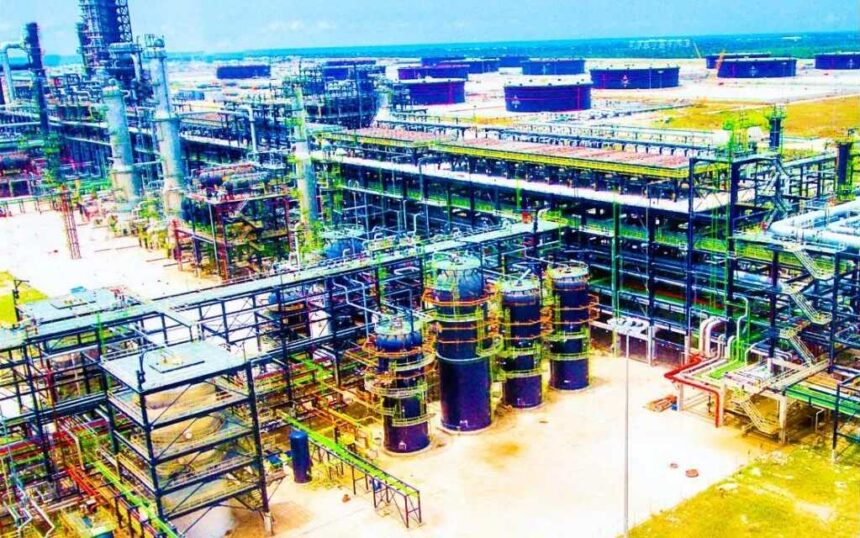
The Dangote Petroleum Refinery and Petrochemicals on Wednesday dismissed as false, misleading, and lacking any commercial or operational basis claims that its petroleum products were being exported to Lome, Togo, and subsequently re-imported into Nigeria at artificially inflated prices.
A statement from the refinery said the allegations represented a deliberate attempt to undermine public confidence in Nigeria’s domestic refining infrastructure at a time when the Dangote Refinery was playing a critical role in reducing the country’s fuel import dependency and improving the trade balance. The refinery said it had no commercial arrangement with any Togolese entity for the re-import of its products.
Allegations Touch a Sensitive Policy Area
Related News
The re-import allegation, if true, would undermine the economic rationale of the naira-for-crude arrangement and the broader domestic refining policy by suggesting that subsidised domestic fuel was being arbitraged across borders at consumers’ expense. The refinery’s flat denial was supported by regulatory officials who said no evidence of a systematic re-import scheme had been identified during recent downstream sector inspections.
The Nigerian Midstream and Downstream Petroleum Regulatory Authority confirmed it was aware of the allegations and was conducting ongoing monitoring of fuel distribution patterns. However, officials said distinguishing legitimate cross-border trade from deliberate arbitrage required detailed forensic analysis of distribution chains and was not something that could be resolved by allegations alone.
Refinery’s Role Remains Critical
Related News
Furthermore, the Dangote Refinery’s contribution to Nigeria’s improving trade balance was confirmed in first-quarter 2026 data showing that petroleum product imports fell sharply as domestic refining output expanded. Nigeria has now become a net exporter of refined petrol, shipping approximately 44,000 barrels per day abroad. Still, the refinery continues to face domestic crude supply shortfalls, having spent $3.74 billion importing foreign crude in 2025 due to NNPCL’s underdelivery. Consequently, while the Togo re-import allegation was denied, the underlying policy vulnerabilities in Nigeria’s downstream petroleum sector remain real and continue to generate public and regulatory scrutiny.