


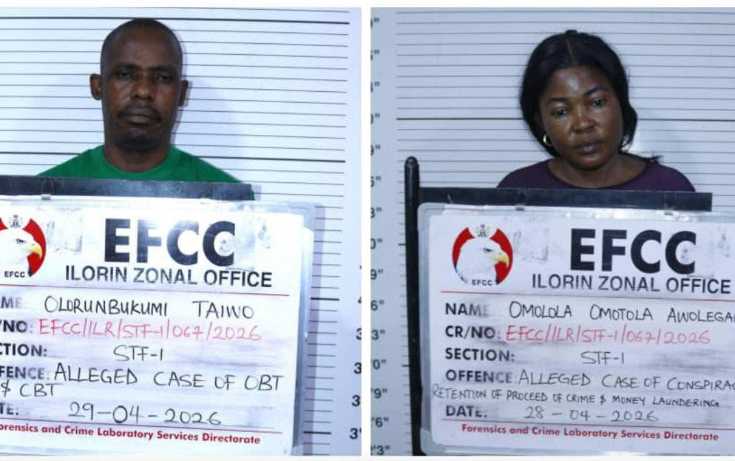
The Economic and Financial Crimes Commission arraigned a husband and wife before a court in Ado-Ekiti, Ekiti State, on Monday, June 9, 2026, on charges related to an alleged N1 billion fraud, in one of the largest financial crime cases to reach a court in the southwestern state in recent memory.
The EFCC’s Ibadan Zonal Directorate confirmed the arraignment in a statement, saying the couple was charged with conspiracy to defraud, obtaining money by false pretence, and converting the proceeds of crime. The commission alleged that the defendants obtained the sum of approximately one billion naira from multiple victims through a scheme that misrepresented their business credentials and the nature of the investment they were soliciting.
Both defendants appeared before the presiding judge and entered not guilty pleas to all counts. The court heard arguments from both the prosecution and the defence on the question of bail before granting the couple bail in a substantial sum with conditions requiring surety documentation, passport surrender, and regular reporting to the commission. The matter was adjourned for the commencement of trial.
Related News
Ekiti’s Enforcement Moment
The timing of the Ado-Ekiti prosecution is notable, coming just days before the June 20 governorship election in the state. The EFCC insisted the arraignment was purely based on the conclusion of its investigation and had no political dimension. The commission said it prosecutes cases when evidence is sufficient, regardless of the political context in which they arise.
However, the appearance of a major fraud case in Ekiti’s courts in the final days of the election campaign is likely to generate political commentary regardless of the EFCC’s stated intentions. Opposition parties in Ekiti have consistently argued that the state needs stronger regulatory oversight of business activity and tighter enforcement of financial crime laws to protect residents and investors alike.
Related News
Furthermore, the case adds to a growing body of EFCC enforcement actions showing that large-scale fraud is not limited to the traditional high-profile centres of Lagos and Abuja but is present across all geopolitical zones. The commission said it was working to strengthen its zonal offices to process cases faster and reduce the backlog of financial crime investigations that accumulate across the country. Notably, the Ado-Ekiti case follows the EFCC’s recent arraignment of Blessing CEO on three separate fraud charges in Lagos, which has drawn enormous national attention to the agency’s enforcement activity. Consequently, the commission enters Democracy Day week with a heavy prosecution calendar that reflects the scale of financial crime challenges facing Nigeria across multiple sectors and locations simultaneously.
INEC Appeals 2027 Timetable Court Judgments
In related legal news, the Independent National Electoral Commission said it had filed appeals against court judgments that altered its 2027 election timetable, explaining that it could not allow judicial interventions to disrupt the operational planning required for the country’s largest electoral exercise. INEC said maintaining a coherent and legally defensible timetable was essential to the credibility of the 2027 general elections. In addition, the commission said it was reviewing cybersecurity protocols for all its digital systems following the report of an anomaly in the CVR portal last week.