

Nigeria’s opposition enters 2027 with its strongest cast of heavyweights in a decade. It is still losing, not to Tinubu on the campaign trail, but to itself.
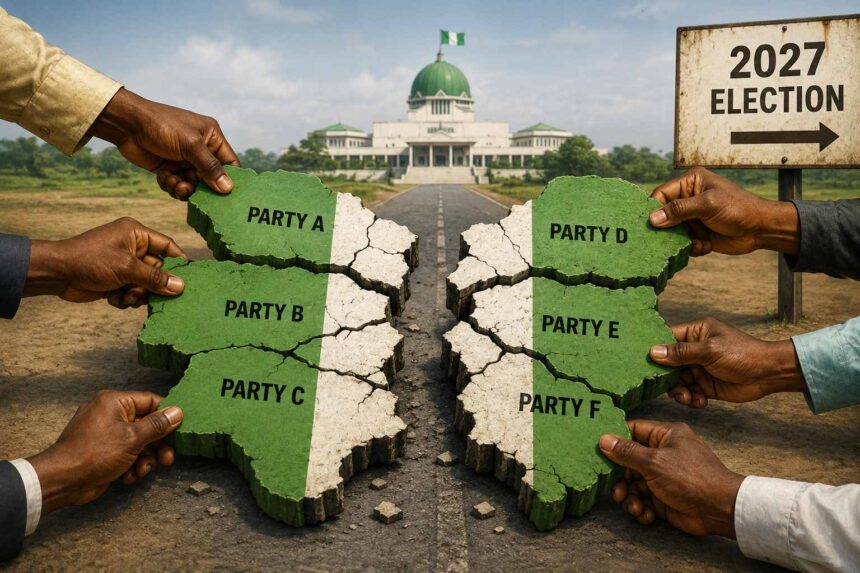
Nigeria’s general election is six months away. The presidential ballot opens on January 16, 2027. And the opposition, armed with two former vice presidents, a two-time presidential runner-up, ex-governors, and enough political capital to fill several campaigns, is fracturing in real time.
Related News
The implosion is not happening on the campaign trail. It is happening in courtrooms, at party congresses, inside WhatsApp group chats, and through serial defections between platforms. The mechanism threatening to hand President Bola Tinubu a second term is not APC dominance. It is opposition self-destruction.
This is an analysis of how that is happening, why it matters, and what the next six months will determine.
Related News
Two Platforms, Same Faces, No Merger
The opposition enters the 2027 cycle split across two main presidential platforms: the African Democratic Congress, ADC, and the Nigeria Democratic Congress, NDC. Both were intended to be the vehicle that finally ended APC’s hold on Aso Rock. Both carry the same recycled set of political heavyweights. Neither shows any serious appetite for a merger.
The ADC coalition was assembled in July 2025 with considerable momentum. Former Vice President Atiku Abubakar, former Senate President David Mark, former Anambra Governor Peter Obi, former Kano Governor Rabiu Kwankwaso, and ex-minister Rauf Aregbesola all came under one platform. In April 2026, a national summit in Ibadan — hosted by Oyo Governor Seyi Makinde and chaired by former President Olusegun Obasanjo — produced the Ibadan Declaration, which pledged a single presidential candidate. It looked, briefly, like 2015 all over again.
It did not last three months.
By May 2026, Peter Obi and Kwankwaso had exited the ADC for the newly registered NDC, citing persistent court cases, internal divisions and an atmosphere they said mirrored the same instability they had fled at the Labour Party. The coalition had broken before it fielded a single candidate.
The ADC Primary: A Coalition’s First Test Becomes Its First Crisis
With Obi and Kwankwaso gone, the ADC proceeded to its presidential primary on May 26, 2026, conducted across 8,809 wards nationwide using the Option A4 open-queuing system. Atiku Abubakar emerged the winner with 1,846,370 votes. Former Rivers State Governor Rotimi Amaechi placed second with 504,117 votes. Economist Mohammed Hayatu-Deen came third with 177,120 votes.
On paper, a decisive result. In practice, the coalition’s first internal democratic exercise immediately became its first internal crisis.
Before the final collation was announced, Amaechi had already publicly rejected the outcome, describing the results as “concocted” and alleging that close to eighty per cent of party members were prevented from voting. Hayatu-Deen went further, boycotted the announcement altogether, citing irregularities he said he personally witnessed, and declined to attend the official declaration. His words carried weight: “A party that criticises the APC and INEC for rigging and writing results cannot engage in the same conduct,” Amaechi warned.
The speed of the subsequent reconciliation effort told its own story. Within hours of the controversy, Atiku visited Amaechi in Abuja alongside Tambuwal and former ADC National Chairman Ralph Nwosu. A closed-door meeting with Hayatu-Deen followed days later. The optics projected unity. The underlying arithmetic did not.
Atiku’s margin — nearly 1.85 million votes against Amaechi’s 504,000 — raised an uncomfortable question inside the coalition: was this primary ever a real contest, or had the outcome been structurally predetermined by Atiku’s vastly superior party machine? The question has not been answered. And an unanswered question of that kind does not simply go away — it hardens into grievance.
The Peter Obi Carousel
The NDC’s own story is no cleaner. Peter Obi’s political journey since 2023 has taken him through APGA, PDP, Labour Party, ADC and now NDC, five platforms in roughly a decade, each exit driven by crisis, litigation or internal pressure.
When Obi and Kwankwaso formally joined the NDC in May 2026, Obi himself acknowledged the pattern explicitly. He pointed to persistent court cases and internal battles within the ADC, warned the NDC’s leadership to keep litigation out of the party, and appealed to the judiciary to resolve outstanding party cases so opposition formations could focus on the actual election.
The Labour Party, still battling its own factional crisis under the disputed chairmanship of Julius Abure, has not been generous in response. In a June 2026 statement, the party warned the NDC directly: those who did not learn from what Obi supporters did to LP’s internal structures would repeat the experience.
Meanwhile, the NDC itself now faces a Federal High Court challenge to its very registration, filed by Ahidjo Ibrahim Karlahi against INEC and the party, questioning whether the NDC’s registration met constitutional and statutory requirements. A separate lawsuit by the Peace Movement Party alleges the NDC’s logo closely resembles its registered emblem. Neither case has been resolved. Both are active ahead of the September 12 candidate list deadline.
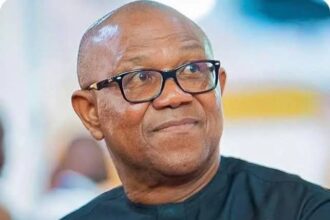
Peter Obi has not helped his own optics. In a public statement last week, the NDC presidential candidate said he was “not certain” about 2027, that no one could guarantee they would be alive to witness or contest the election. The remark, framed as philosophical humility, was widely read as a signal of diminishing confidence in the entire enterprise.
The Legal War Nobody Is Winning
Across the opposition landscape, the most consequential battles in the next six months will not be fought at campaign rallies. They will be fought in court.
At least six active lawsuits are directly targeting INEC’s 2027 election framework. A Federal High Court in May 2026 nullified portions of INEC’s revised election timetable, ruling that the commission had exceeded its statutory powers by imposing deadlines on party primaries and candidate submissions that were shorter than what the Electoral Act 2026 permits. INEC has appealed. A second similar ruling followed, filed by the Social Democratic Party. Both are before the Court of Appeal.
More critically for the ADC: a Federal High Court had ordered INEC to deregister five parties, ADC, Accord, Action Alliance, Action People’s Party and Zenith Labour Party, citing failure to meet constitutional electoral performance thresholds from the 2023 cycle. The affected parties filed appeals. The Court of Appeal granted a stay of execution. That appellate hearing was adjourned from July 7 to July 14, 2026, the same day as INEC’s extended candidate submission deadline. The convergence of those two dates is not a minor scheduling coincidence. It is an existential pressure point for the ADC’s entire 2027 operation.
Inside the PDP, the oldest opposition brand. A separate leadership dispute between the Turaki-led faction and a rival group backed by former Rivers Governor Nyesom Wike now threatens the validity of 1,393 candidate nominations for the National Assembly and State Assembly elections. The suit seeking court-ordered recognition of the Turaki faction is scheduled for a possible determination on July 17, a week after INEC’s original submission deadline. As of today, no compromise between the two factions has been reached.
The Structural Problem Nobody Wants to Say Out Loud
Behind the litigation and the defections, a harder truth sits in the data. With at least two major opposition presidential candidates, Atiku on the ADC and Obi on the NDC, and potentially more from smaller platforms, the anti-APC vote faces the same split-vote problem that helped Tinubu win in 2023 with 36.6 per cent of the total votes cast.
The Ibadan Declaration committed the opposition to one presidential candidate. That commitment lasted less than a month before Obi and Kwankwaso left for the NDC. There is currently no active negotiation between the ADC and NDC on a unity candidate. Both platforms are running parallel presidential operations with overlapping voter bases and competing narratives.
Political analysts who track the electoral data have said plainly: a fragmented opposition against a ruling party that controls the governors of more than 30 states and has secured endorsements across every geopolitical zone does not need a miracle to win. It needs the opposition to keep doing exactly what the opposition is currently doing.
The Warning from History
This morning, the Igbo Leaders of Thought, an assembly of Southeast intellectuals and stakeholders, issued a public statement warning that the systematic suppression and internal fracturing of opposition parties poses a direct threat to Nigeria’s democratic stability. The group invoked 1962’s Operation Wetie in Western Nigeria, the political violence that triggered the chain of events leading to the first military coup on January 15, 1966. It also cited the 2011 post-election bloodshed in Northern Nigeria, which Human Rights Watch documented as claiming over 800 lives.
The ILT’s warning was directed at those in power. But it applies equally to those seeking power. A democratic system in which the opposition cannot hold itself together long enough to conduct a credible primary, choose a unified candidate, or keep its parties legally registered is not a system that produces peaceful transfers of power. It is a system under serious stress.
What the Next Six Months Will Decide
Several legal and political deadlines will determine the shape of Nigeria’s 2027 race before the year ends. The Court of Appeal’s ruling on ADC deregistration, due July 14, will establish whether Atiku’s platform survives intact. The PDP leadership suit, July 17, will determine whether over a thousand opposition candidates can even appear on the ballot. INEC’s final candidate list, September 12, will be the last major structural marker before the campaign enters its final phase.
Between now and January 16, 2027, the opposition needs to do several things it has so far proven unable to do simultaneously: resolve its internal legal battles, reconcile its aggrieved primary losers, decide whether to pursue a unity candidate or accept a split-vote race, and build a nationwide campaign infrastructure capable of matching a ruling party with 30-plus governors behind it.
The structural conditions for a competitive 2027 election exist. Economic pain is real and widespread. Insecurity has worsened. Peter Obi himself told Tinubu publicly last week to “resign over governance failures or skip 2027,” pointing to the 52-day absence of presidential communication with Oyo’s governor during the ongoing hostage crisis involving 39 schoolchildren and seven teachers abducted on May 15. The opposition has legitimate grievances to campaign on.
What it does not yet have is the discipline to campaign on them together.
That gap between legitimate grievance and organisational coherence is where Tinubu’s second term currently lives.
KEY DATES TO WATCH
| DATE | MILESTONE |
| July 14, 2026 | INEC extended candidate submission deadline |
| July 14, 2026 | Court of Appeal rules on ADC deregistration bid |
| July 17, 2026 | PDP leadership suit — Federal High Court determination |
| September 12, 2026 | INEC publishes final presidential/NASS candidate list |
| January 16, 2027 | Presidential & National Assembly elections |
| February 6, 2027 | Governorship & State Assembly elections |