

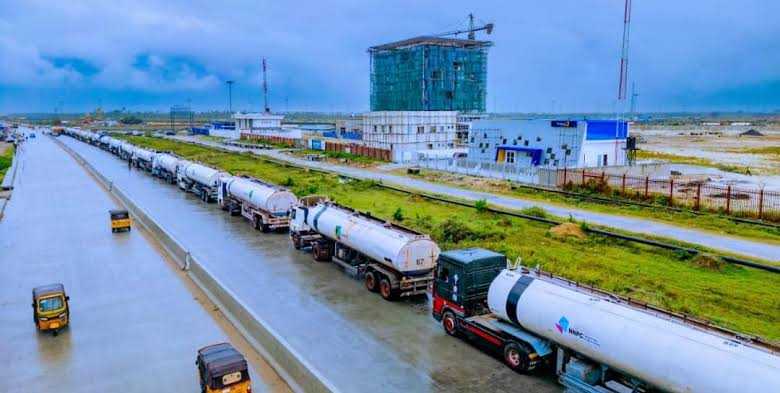
The Dangote Petroleum Refinery’s decision to begin free petrol delivery to Abuja and five states marks a bold entry into Nigeria’s downstream market. According to Punch Newspapers and Vanguard, the move is part of a phased rollout strategy designed to test supply chains, build confidence among stakeholders, and demonstrate the refinery’s operational capacity.
The refinery, Africa’s largest single-train facility, announced that the free deliveries would serve as pilot consignments to Abuja, Lagos, Kano, Rivers, Enugu, and Kaduna. Industry insiders explained that the initiative is not a commercial giveaway but a strategic demonstration of readiness to meet Nigeria’s fuel demand.
By absorbing initial logistics costs, Dangote aims to showcase efficiency in distribution while reassuring regulators, marketers, and consumers of its ability to stabilise supply.
Related News
Nigeria’s downstream sector has long been plagued by supply disruptions, foreign exchange pressures, and reliance on imported refined products. The Dangote refinery, with a capacity of 650,000 barrels per day, is expected to reduce import dependence and strengthen energy security.
Analysts note that the free delivery signals confidence in the refinery’s production line and logistics network. It also positions Dangote as a disruptor in a market dominated by imports and government-regulated pricing.
The refinery’s entry comes at a time when Nigeria is grappling with inflation and foreign exchange volatility. By reducing reliance on imported petrol, the refinery could ease pressure on the naira and improve trade balances.
Related News
However, experts caution that the long-term impact will depend on pricing, distribution efficiency, and regulatory alignment. While free deliveries generate goodwill, sustained market stability requires competitive pricing and consistent supply.
Officials from the Nigerian Midstream and Downstream Petroleum Regulatory Authority (NMDPRA) welcomed the initiative, describing it as a milestone in Nigeria’s energy transition. They emphasised that the refinery’s operations must align with national policies on pricing, quality standards, and distribution.
The federal government has repeatedly highlighted the refinery as a cornerstone of its economic diversification agenda. The free delivery initiative reinforces that narrative, projecting Nigeria as a potential hub for refined petroleum exports in West Africa.
Petrol marketers in Abuja and the five states expressed optimism, noting that the refinery’s entry could ease supply bottlenecks. Some, however, raised concerns about long-term pricing and the sustainability of distribution networks.
Consumers welcomed the development, though many remain cautious about whether the refinery’s operations will translate into lower pump prices.
Dangote’s free delivery strategy illustrates how large-scale projects can leverage symbolic gestures to build market confidence. By prioritising supply chain testing and stakeholder reassurance, the refinery is laying the groundwork for full-scale commercial operations.
For Nigeria’s business community, the lesson is clear: strategic market entry requires more than production capacity—it demands trust-building, transparency, and alignment with national economic goals.
The Dangote refinery’s free petrol delivery to Abuja and five states is more than a logistical exercise. It is a signal of Nigeria’s evolving energy landscape and a test of the refinery’s ability to reshape the downstream sector.
For both national and international readers, the development underscores the refinery’s potential to reduce import dependence, stabilise supply, and redefine Nigeria’s role in global energy markets. The coming months will reveal whether this bold entry translates into lasting economic gains.