


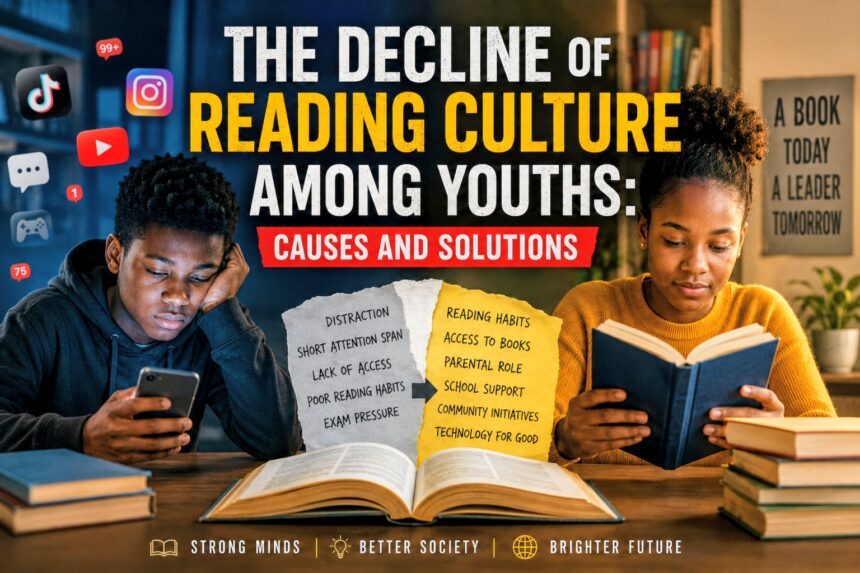
In an age dominated by smartphones, instant messaging and endless streams of short-form videos, the culture of reading among young people is steadily fading. Across schools, homes and public spaces, it is becoming increasingly rare to find youths deeply engaged with books, newspapers or long-form educational materials. Instead, attention has shifted toward digital entertainment and fast-paced social media consumption.
The decline in reading culture among youths is no longer merely an educational concern; it is gradually evolving into a social and intellectual crisis with long-term implications for national development, creativity, communication and critical thinking.
Related News
Reading Culture in Decline
For decades, reading was regarded as one of the strongest pillars of academic excellence and personal growth. Young people spent hours studying novels, magazines, biographies and newspapers, often developing strong analytical and communication skills in the process.
Today, however, many educators and parents observe a worrying trend: youths are reading less and scrolling more.
The rise of social media platforms such as TikTok, Instagram and YouTube has transformed how information is consumed. Content is now packaged in shorter, faster and more visually stimulating formats that demand little concentration span. As a result, sustained reading increasingly feels difficult for many young people.
Experts argue that the constant exposure to rapid digital content has significantly affected attention spans. Rather than processing detailed information through books and articles, many youths now prefer snippets, captions and quick videos that deliver instant gratification.
The Digital Revolution and Its Consequences
Technology itself is not the enemy. In fact, digital innovation has expanded access to information more than at any other point in history. The real challenge lies in how technology is being used.
Many youths spend several hours daily on entertainment-based applications while dedicating very little time to intellectual reading. This imbalance has contributed to declining comprehension skills, weak vocabulary development and reduced critical reasoning abilities.
The addiction to notifications, trends and online engagement has also created a culture of distraction. Reading, which requires patience, focus and mental discipline, struggles to compete within this environment.
Educational stakeholders warn that this shift may eventually affect academic performance, professional competence and leadership capacity if left unchecked.
The Role of Homes and Schools
Beyond technology, the home environment also plays a major role in shaping reading habits.
In many households today, children grow up without seeing parents or guardians actively reading books, newspapers or educational materials. Where reading is not modeled, it becomes difficult to cultivate naturally among younger generations.
Similarly, schools in many developing countries often emphasize examinations and certificates more than knowledge acquisition and intellectual curiosity. Students are frequently encouraged to read only for tests rather than for self-development or pleasure.
This has turned reading into a burdensome academic activity instead of an enriching lifestyle.
The decline of libraries in many communities has further worsened the situation. Limited access to quality books and poorly equipped public libraries reduce opportunities for young people to interact meaningfully with literature and educational content.
Why Reading Still Matters
Despite technological advancements, reading remains one of the most powerful tools for personal and societal development.
Consistent reading improves vocabulary, strengthens writing ability, enhances imagination and sharpens analytical thinking. It also exposes readers to diverse perspectives, cultures and ideas, helping to build informed and responsible citizens.
Young people who cultivate strong reading habits are generally better equipped to communicate effectively, solve problems creatively and compete in highly demanding academic and professional environments.
Nations with strong reading cultures often enjoy higher literacy levels, better educational outcomes and stronger intellectual communities.
Reviving the Reading Culture
Experts believe the decline can still be reversed through deliberate efforts by families, schools, governments and society at large.
One effective approach is integrating reading into modern technology. Digital reading applications, e-books and audiobooks can help make reading more attractive and accessible to tech-oriented youths. Platforms such as Kindle have already demonstrated how technology can support reading rather than replace it.
Schools also have a responsibility to revive literary engagement by organizing reading competitions, book clubs, storytelling sessions and dedicated library hours. Students should be encouraged to read beyond examination materials.
Parents, too, must become intentional about creating reading-friendly environments at home. Children are more likely to embrace books when they observe adults around them valuing reading.
Governments and private organizations can support these efforts by investing in libraries, subsidizing educational books and promoting literacy campaigns across communities.
A Generation at a Crossroads
The battle for the minds of young people is increasingly being fought in the digital space. While entertainment and social media continue to shape modern lifestyles, experts insist that reading must not be allowed to disappear from the culture of the younger generation.
The future of any society depends largely on the intellectual strength of its youths. A generation that abandons reading risks weakening its ability to think critically, innovate meaningfully and contribute productively to national progress.
Reviving the reading culture may require adaptation to modern realities, but its importance remains timeless.
In the end, books still hold something no algorithm can fully replace: depth, reflection and the power to transform minds.