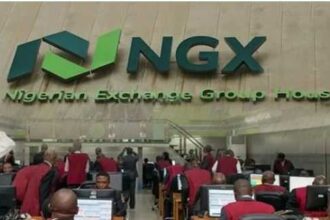


The Nigerian Exchange Limited recorded a market capitalisation gain of approximately N515 billion on Tuesday, June 10, 2026, as investors renewed buying interest across several sectors ahead of the public holiday on Thursday, June 12, with the All-Share Index posting one of its strongest single-session recoveries of the month.
Market data showed broad-based buying activity across banking, consumer goods, telecommunications, and industrial sectors, with the NGX All-Share Index closing significantly higher than Monday’s session. Stockbrokers attributed the rebound to renewed domestic institutional interest, improved risk appetite among foreign portfolio investors tracking Nigeria’s improving macroeconomic fundamentals, and pre-holiday position adjustments.
The session’s gains added to a strong 2026 performance trajectory for the Nigerian capital market. President Tinubu had in January 2026 praised the NGX for crossing the historic N100 trillion market capitalisation milestone, describing it as a signal to the world that the Nigerian economy was robust and productive. The NGX All-Share Index closed 2025 with a 51.19 per cent return, one of the highest in the world, outperforming the S&P 500, the FTSE 100, and most emerging-market peers.
Related News
CBN Treasury Bills Oversubscribed Three Times
Meanwhile, the CBN’s latest treasury bill auction was oversubscribed by approximately three times the amount on offer, with investors bidding N300 billion for N100 billion worth of bills on offer. The oversubscription reflected continued strong demand for Nigerian fixed-income instruments, driven by high yields on government securities and improving confidence in Nigeria’s ability to service its domestic debt obligations.
However, financial analysts noted that the high demand for treasury bills also reflects the elevated interest rate environment maintained by the CBN, where the Monetary Policy Rate stands at 27 per cent. Critics said the high rate environment, while effective at attracting capital and controlling inflation, was raising the cost of government borrowing and crowding out credit to the private sector. Furthermore, the composite PMI holding below 50 at 49.6 suggested that despite strong capital market performance, real sector business conditions remained under pressure.
Related News
Still, the government’s macroeconomic narrative received several boosts simultaneously this week. The NBS trade surplus data, the NGX rebound, the CBN treasury bill oversubscription, and the approach of the $50 billion external reserves target all contributed to a positive economic story on the eve of Democracy Day. Notably, the CBN governor said the apex bank remained firmly focused on inflation reduction and exchange rate stability as its primary policy objectives for the rest of 2026. Consequently, investors appear increasingly willing to bet on Nigeria’s economic direction even as ordinary citizens continue to report persistent pressure from elevated food prices, transport costs, and utility bills that have not yet eased in line with improving headline indicators.
FG Sets New Imprest Limits for Ministries
In addition, the federal government issued a directive setting new imprest limits for ministries, departments, and agencies, capping ministers’ reimbursable funds at N700,000 per quarter as part of a broader effort to tighten expenditure controls and reduce wasteful government spending. The directive was seen as a signal of the administration’s stated commitment to fiscal discipline. As a result, the government is simultaneously managing the political demands of the Democracy Day showcase while implementing administrative reforms designed to improve value for money in public expenditure.