

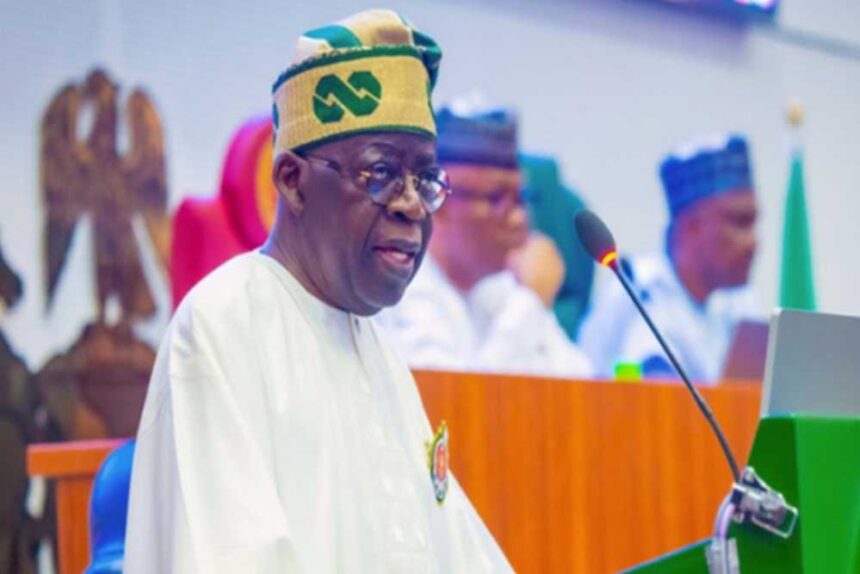
President Bola Tinubu is scheduled to address a joint session of the National Assembly on Thursday, June 12, 2026, as Nigeria marks its 27th Democracy Day anniversary, with the federal government rolling out a full programme of commemorative events themed around Nigeria’s journey since the return to civilian rule in 1999.
The announcement was made by Secretary to the Government of the Federation, Senator George Akume, during the inauguration of the Inter-Ministerial Committee coordinating this year’s national celebration. Akume said the President’s address to the National Assembly would be one of the major highlights of the day’s events, alongside a national inter-denominational church service, a Democracy Day press conference, and a gala night.
Akume, speaking on behalf of President Tinubu at the National Inter-Denominational Church Service held at the National Christian Centre in Abuja, declared that Nigeria would never succumb to terror or banditry. ‘Government is sensitive to all these pains, shares in these pains and has heard your cries,’ he said, pledging that President Tinubu would intensify efforts to address the socioeconomic challenges facing Nigerians. He also congratulated citizens on 27 years of uninterrupted democratic governance since 1999.
FG Highlights Three Years of Reforms
The Democracy Day celebration coincides with the third anniversary of the Tinubu administration, and the federal government used the occasion to present what it described as a three-year reform scorecard. Information Minister Mohammed Idris said the administration had made significant progress in economic reform, security, anti-corruption, social welfare delivery, and national cohesion since May 2023.
The government cited the removal of fuel subsidies and forex market liberalisation as landmark structural reforms, the S&P credit rating upgrade from B-minus to B as external validation of its economic management, and the joint US-Nigeria operation that killed ISIS global second-in-command Abu-Bilal al-Minuki as proof of measurable security progress. Furthermore, the EFCC’s recovery of over N50 billion channelled into the Nigerian Education Loan Fund was highlighted as an anti-corruption achievement.
However, opposition politicians, civil society groups, and citizens took to social media to offer a sharply different assessment, pointing to the worsening insecurity crisis, rising cost of living, and unresolved school abductions in Oyo and Borno as evidence that the Renewed Hope Agenda had not yet delivered tangible improvements for ordinary Nigerians. Still, the administration maintained that the reforms were working and that their full impact would become clear over the medium term. Notably, the Democracy Day address will give President Tinubu a major platform to speak directly to Nigerians about the road ahead. Consequently, the speech is being watched closely across the political spectrum for signals about the government’s direction on insecurity, the economy, and governance in the run-up to 2027.
MKO Abiola’s Legacy Honoured
Meanwhile, tributes poured in for the late Moshood Kashimawo Olawale Abiola, whose annulled victory in the June 12, 1993 presidential election gave the date its democratic significance. In addition, pro-democracy activists who suffered persecution during the military era were honoured in statements by civil society organisations and the Presidency alike. As a result, Democracy Day 2026 carries both a backward-looking tribute to sacrifice and a forward-looking challenge to the country’s democratic institutions.