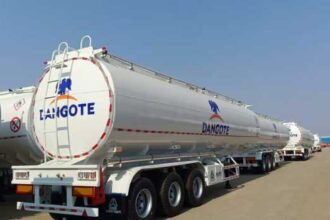


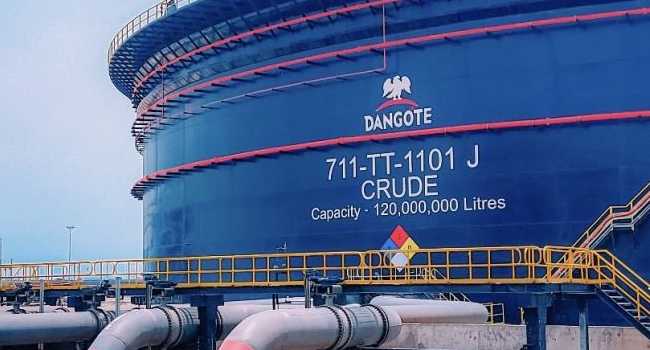
The Dangote Petroleum Refinery is grappling with a deepening domestic crude supply crisis despite Nigeria recording its highest oil production level of 2026 in April, with combined crude and condensate output reaching 1.663 million barrels per day, according to data from the Nigerian Upstream Petroleum Regulatory Commission.
Nigeria’s domestic refineries were allocated 61.9 million barrels of crude in the first quarter of 2026 under the naira-for-crude arrangement, but actual delivery reached only 28.5 million barrels, leaving more than half of the policy-backed supply absent from the physical market. The significant gap between allocation and delivery has forced the Dangote Refinery to import foreign crude from markets including Brazil, the United States, and Algeria to maintain operations.
In 2025, the Dangote Refinery spent $3.74 billion importing foreign crude, approximately N5.73 trillion, to supplement the domestic supply it was not receiving at the scale required to run its 650,000-barrel-per-day capacity efficiently. A senior management source at the refinery described the situation as one that eroded the cost-benefit of local refining. ‘Buying Nigerian crude grades on the global market at international benchmark prices plus transport and insurance costs erodes the cost-benefit of local refining,’ the source stated.
Related News
Export Commitments Versus Domestic Needs
Industry analysts say the root of the problem is that a significant portion of Nigeria’s produced crude continues to be exported under long-term contracts, leaving inadequate volumes for domestic delivery to the Dangote Refinery even when total national production is rising. Nigeria exported 55.39 million barrels in the first two months of 2026, reinforcing the structural tension between export revenue maximisation and the government’s stated goal of ending fuel import dependence.
Aliko Dangote has publicly acknowledged the supply challenge, noting that while the refinery has the capacity to stabilise the entire African sub-region, the domestic pricing and supply environment must be harmonised before that potential can be realised. The NNPCL said it had increased scheduled allocations from five cargoes to ten cargoes per month in response to the refinery’s complaints, but the impact on actual delivery volumes remained unclear.
Related News
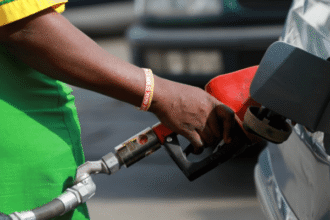
However, Femi Otedola, chairman of First HoldCo Plc, said he remained optimistic that the naira could strengthen significantly once the Dangote Refinery reached consistent full operational capacity. ‘With domestic refining now firmly underway after decades of reliance on imports, pressure on the foreign exchange market should ease significantly,’ Otedola said in a February statement that continues to be referenced by energy analysts. Notably, fuel pump prices at Dangote-supplied outlets have declined from approximately N1,500 per litre to around N1,000 per litre since the refinery came online. Consequently, partial operational success has already delivered consumer benefits, but the full economic impact awaits resolution of the crude supply bottleneck.
Expansion Plans Signal Long-Term Ambition
Furthermore, the Dangote Group announced a $12 billion expansion project aimed at doubling the refinery’s output to 1.4 million barrels per day within three years, with off-grid power generation also being scaled from 500 megawatts to 1,000 megawatts. In addition, Nigeria’s oil market has fundamentally shifted since the refinery opened, with the country now importing crude, refining it locally, and exporting petroleum products worth $5.85 billion in 2025, compared to a $14.06 billion fuel import bill in 2024. As a result, the trajectory is clearly positive, but closing the delivery gap between allocation and actual crude supply remains the defining challenge for the sector in 2026.