

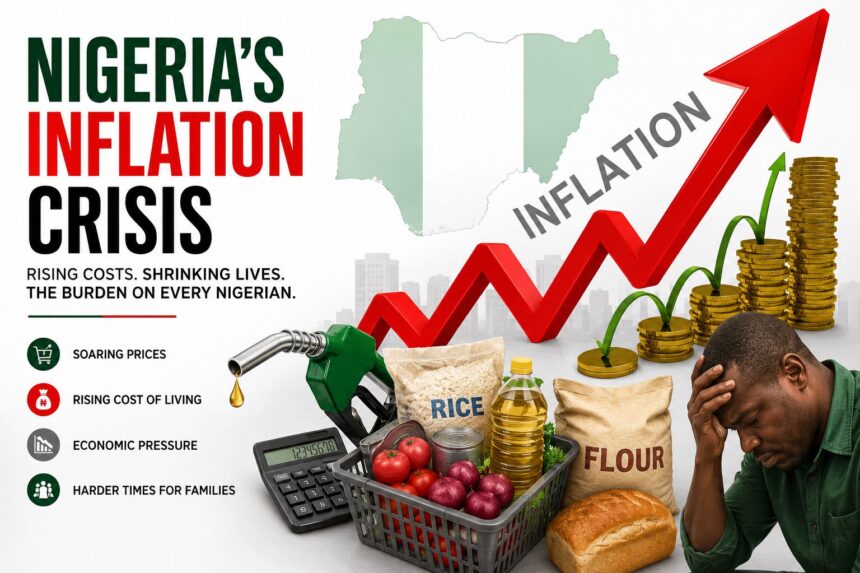
The National Bureau of Statistics released its latest inflation report last week. Headline inflation sits at 15.69 percent. Food inflation stands at 16.06 percent. The ministry of finance called it “encouraging progress.” But here is the thing about statistics. You cannot eat them. And when a mother in Kano tells me she has gone from three meals a day to one, she is not calculating percentage points. She is calculating survival.
Here is what most people get wrong about Nigeria’s inflation crisis. The official figures are not lies. The truth is they are incomplete. They measure prices in markets that many Nigerians no longer have the money to enter. And here is why that matters right now: because when the gap between what the government says and what citizens feel grows wide enough, something breaks. And that something is usually peace.
Related News
What the official report won’t tell you
The NBS does good work. Its methodology is sound. Its analysts are professionals. But the report buries the real story in its own footnotes. Food, transport, hospitality, and healthcare costs account for 87 percent of inflationary pressure. These are not luxury items. These are the things without which a human being cannot live. Economist Muda Yusuf put it plainly. The disinflation process remains highly vulnerable to external shocks. Global energy prices rise. Nigerian food prices follow. There is no buffer. There is no safety net.
The difference between inflation figures and hunger is the difference between a weather forecast and a flood. One tells you what is happening. The other tells you what you have lost.
Related News
My neighbour stopped buying beef six months ago. My cousin in Lagos now takes the bus only three days a week. My aunt in Enugu has replaced rice with unripe plantain because it stretches further. These are not anecdotes. These are data points that do not fit into spreadsheets.
To be fair…
Let me acknowledge what the government would say. Inflation is a global problem. The war in Ukraine. Supply chain disruptions. Fuel prices. Nigeria did not create these forces. And compared to some of our neighbours, 15 percent looks almost manageable. The Central Bank has raised interest rates. The Ministry of Finance has rolled out palliatives. They are not doing nothing.
But here is where that argument hits a wall. Palliatives that do not reach the poorest are not palliatives. They are photo opportunities. And raising interest rates might cool the economy on paper, but it also makes borrowing impossible for the small business owner who just needs to buy one more bag of rice to sell. The tools the government is using were designed for a different kind of economy. They are treating a broken leg with paracetamol.
You cannot tighten your way out of a hunger crisis. You can only grow or distribute your way out. And we are doing neither fast enough.
The human cost
I spoke to a trader at Alaba International Market last week. Three years ago, she was saving to send her daughter to university. Today, she is saving to buy beans. She did not ask for my name to be used. She is afraid. Not of me. Of what happens if she speaks and the wrong person hears. That is the invisible cost of this crisis. It is not just empty pots. It is silenced voices.
The numbers confirm her story. Food inflation is driven by millet, yam flour, beef, garri, and beans. The staples. The things that appear on almost every Nigerian table. When a bag of rice becomes a luxury, you have crossed a line. And crossing back is never simple.
So what do we do now
Short term, the government must stop pretending that photo-sharing palliatives are enough. Cash transfers need to reach the people who have no bank accounts. Food reserves need to be released before hoarders empty them. Medium term, Nigeria must fix its agricultural supply chain. Farmers cannot get produce to markets because roads are death traps and fuel is expensive. Long term, we need a conversation about what kind of economy leaves its citizens choosing between feeding their children and feeding themselves.
Here is where we land. Inflation figures are useful for economists. They are useless for hungry people. The government can report whatever numbers it likes. The only number that matters is the one written on the heart of every Nigerian who went to bed hungry last night. Until that number is zero, no press release will convince anyone that things are getting better.
Alfred O. Chalse
FCT Abuja