


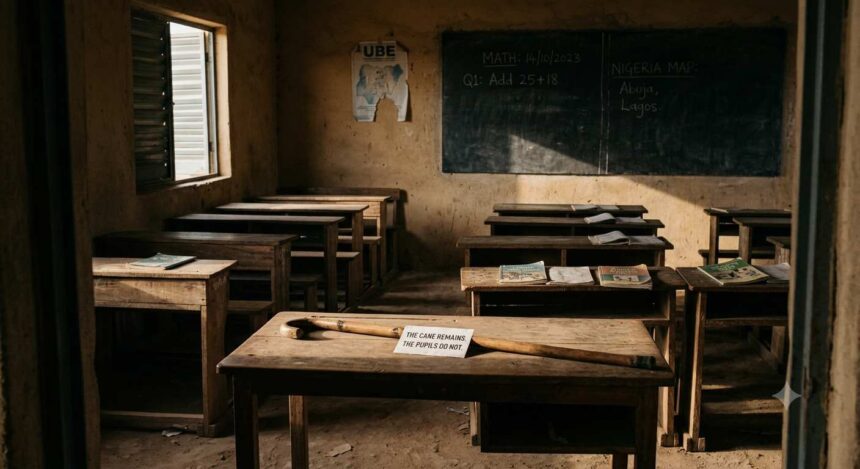
A 12-year-old boy is dead. A teacher is on the run. And the law that should have protected him has been sitting, unenforced, for over two decades.
His name has not been released. He was twelve years old. On the evening of July 16, 2026, he was rushed from a school in Adazi-Ani, Anaocha Local Government Area of Anambra State, to a nearby hospital. A doctor confirmed him dead while he was still receiving treatment. Preliminary examination revealed visible marks of violence across different parts of his body.
Related News
The teacher who allegedly flogged him to death fled the school immediately after the incident. Police declared her wanted. Two days later, she surrendered voluntarily to the Anambra State Police Command, which had activated its Safe School Initiative unit and placed the Assistant Commissioner of Police in charge of Operations, ACP Harrison Oruruo, at the head of the search team.
A boy is dead. A teacher is in custody. And Nigeria is, once again, having the same conversation it has been having for years, without resolution: when does discipline become murder?
A Law That Exists on Paper Only
Nigeria has a Child Rights Act. It was enacted in 2003. All 36 states have domesticated it. On paper, it is one of the most comprehensive child protection frameworks on the African continent, aligned with the United Nations Convention on the Rights of the Child, which Nigeria has also ratified.
The Act prohibits corporal punishment of children in all settings — schools, homes, alternative care. A child, under its provisions, has the right to dignity. The right to protection from physical abuse. The right not to be hit.
But open the Criminal Code and the Penal Code — the older laws still governing much of Nigerian jurisprudence — and a different picture emerges. Article 295 of the Criminal Code and Article 55 of the Penal Code both affirm the right of parents and those in positions of authority over children to use force in correction. The two frameworks sit side by side in the same legal system, saying opposite things, and the tension between them has never been conclusively resolved by either the legislature or the courts.
The result, documented in a 2024 legal review published by the International Journal of Law and Social Science Studies, is exactly what you would expect from conflicting laws in a country where enforcement is already weak: impunity. Many more cases of corporal punishment continue to occur across Nigeria, the review noted, with only a few ever being reported and far fewer prosecuted.
What a School Day Can Cost a Child
Adazi-Ani is a community in Anaocha Local Government Area, a farming and trading town in the heart of Anambra State. It is not a city. It does not have the large private academies of Lagos or the federal government schools of Abuja. It is the kind of place where a teacher is a figure of almost unchallenged authority, where a parent sends a child to school in the morning and expects to see them come home in the evening, and where the idea that a teacher could beat a child to death sits so far outside the normal that the community may still be in shock.
The boy whose name has not been released did not come home on July 16. His family received him in a hospital, already gone. The photographs taken by police at the scene showed his body bore the marks of what had been done to him.
This is not the first time Nigeria has been here. In 2016, a 14-year-old girl in a private school in Ibadan, Oyo State, was a victim of corporal punishment so severe it became a national story. In 2023 and early 2024, a series of deaths and hospitalisations from school beatings were reported across multiple states. A female lawyer in Onitsha was arrested in 2024 for brutalising her 10-year-old domestic help with a hot iron and a kitchen knife. The incidents keep coming. The conversation restarts. Then the public forgets, with less publicity to teach the intending evil perpetrators about what becomes those who tread the same path.
The Government’s Promise — and the Gap
In late 2024, ahead of the first United Nations ministerial conference on violence against children, Nigeria made a public pledge. The federal government committed to banning corporal punishment in schools as part of a broader investment in national Safe Schools financing between 2024 and 2026. Nigeria’s pledge was noted internationally. Officials cited it as evidence of political will.
The July 16 incident in Adazi-Ani happened inside that funding window. Inside that pledge. Inside the period when those fundings were supposedly being deployed to make schools safer.
The gap between announcement and reality is not new in Nigeria. Educators, child rights advocates and legal scholars have pointed to the same failure point for years: the political will to enforce existing laws is simply not there. A level-12 education officer, speaking to The Guardian during a 2024 investigation into the issue, put the dilemma plainly: punishing corporal punishment completely, he said, risks producing what he called disrespectful and ungovernable students. His candour was revealing. Inside the institution responsible for child welfare in schools, the cultural argument for the cane is still being made — even by civil servants.
What the Research Actually Says
The argument that corporal punishment builds discipline has been studied extensively. It does not hold up.
The World Health Organisation has stated unequivocally that corporal punishment undermines children’s development and wellbeing. Research published in academic journals on school violence has consistently found that physical punishment in school settings correlates with higher rates of aggression, lower academic performance, and long-term psychological harm — not the discipline outcomes its defenders claim.
The same body of research identifies clear alternatives: counselling, restorative dialogue, structured consequence systems, and constructive communication. None of these require a cane. None of them leave marks on a child’s body. None of them have produced a 12-year-old in a hospital mortuary.
Nigeria’s own Child Rights Act points to these alternatives explicitly. The legal framework for non-violent discipline already exists. What does not exist, consistently, is the will to apply it.
After the Surrender
Mrs. Dim Ebere, 47, surrendered to the Anambra State Police Command after two days as a fugitive. The circumstances of her surrender — whether it came from pressure, from fear, or from something else entirely — have not been fully reported. The police confirmed she is now in custody. The case is under active investigation.
The Anambra Police Command expressed what it called deep concern over the tragic incident and assured the family of the deceased and members of the public that it would conduct a thorough, diligent, and transparent investigation. Members of the public with information were urged to contact the command’s emergency line.
What happens next matters. Cases like this have a habit of moving quickly through public consciousness and slowly through the justice system. The teacher will be prosecuted, or she will not. The school will be investigated, or it will not. The Safe Schools funds will produce visible change in Anambra classrooms, or it will not.
A 12-year-old boy’s family is not waiting for the policy conversation to resolve itself. They buried their son.
The Question Nigeria Keeps Avoiding
There is a question at the centre of this story that Nigerian society — its lawmakers, its school administrators, its parents, its teachers — has not yet answered honestly.
If a teacher beats a child and the child dies, is that murder? The law says yes, in principle. But the culture that produced that teacher, that placed a cane in her hand as a management tool, that treated corporal punishment as a normal feature of school discipline for generations — that culture is still very much alive inside Nigerian classrooms. The Child Rights Act exists. The Penal Code also exists. And when those two things sit side by side without resolution, it is the child who pays the price.
The cane has been in Nigerian classrooms for longer than the Nigerian state has existed. Removing it will require more than a pledge at a UN conference, more than billions in a budget line, and more than another round of public outrage that fades before the next term begins. It will require the kind of sustained, enforced, structural change that Nigeria has proven capable of, when it decides that something is serious enough to demand it.
A 12-year-old in Adazi-Ani did not live to see that decision made.