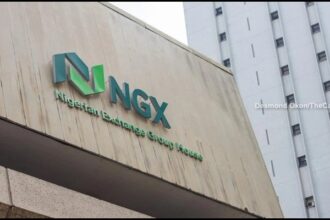


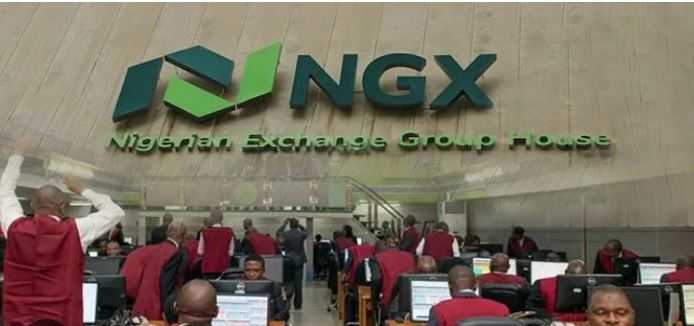
The Nigerian Exchange’s market capitalisation held firm above 156 trillion naira, approximately 115 billion dollars, this week despite a slight dip recorded during Monday’s trading session, with Nigeria maintaining its position as Africa’s best performing equity market for 2026 amid a sustained currency-backed bull run.
Trading data for Monday, June 15, showed the All-Share Index closing at 156.1 trillion naira in total market capitalisation after a session in which 569,086,165 shares changed hands across 77,560 deals, representing a market value of approximately 31.4 billion naira. The session saw 20 gainers against 47 losers, with Royal Exchange leading gainers at 10 per cent appreciation, followed by Ikeja Hotel, Neimeth International Pharma, and University Press.
BusinessDay analysis of African Markets data earlier in the year showed Nigeria’s benchmark index gaining 34.4 per cent in dollar terms year to date as of February, the highest return among 17 African bourses tracked, driven by a stronger naira, renewed foreign investor appetite, and sustained domestic institutional buying. The NGX’s outperformance has been widely interpreted as a signal of improving investor confidence in Nigeria’s macroeconomic reforms and foreign exchange stability.
Related News
Dangote, Rabiu Lead Billionaire Wealth Gains
The equity rally has rapidly boosted the fortunes of Nigeria’s industrial elite, with Aliko Dangote and BUA Group founder Abdulsamad Rabiu posting the largest wealth gains among African billionaires this year, according to BusinessDay’s tracking of African wealth data. The gains reflect both the strong performance of their respective listed and unlisted business interests and the broader currency and capital market tailwinds supporting Nigerian asset values.
However, market analysts cautioned that capital market gains, while encouraging, do not automatically translate into broad-based economic benefits for ordinary Nigerians, particularly given the CBN’s own Business Expectations Survey showing a persistently negative employment outlook despite improving business sentiment. Furthermore, the naira’s performance has shown volatility throughout 2026, depreciating to N1,387 per dollar in March before staging a rebound to N1,342.50 by mid-April, illustrating that currency strength, while broadly positive, has not been a smooth uninterrupted trajectory.
Related News
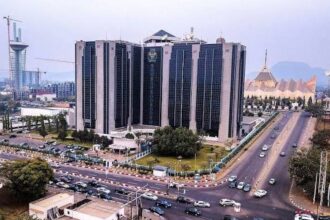
Still, CBN Governor Olayemi Cardoso maintained that Nigeria’s improved external buffers and resilience had been widely acknowledged by the IMF, World Bank, and other development partners, crediting deliberate exchange rate and macroeconomic policy actions for helping the country absorb global shocks more effectively than in previous years. Notably, the Nigerian Economic Outlook for 2026 projects the naira trading within a range of 1,410 to 1,519 per dollar for the year, with inflation expected to moderate to between 12 and 16 per cent. Consequently, despite periodic volatility, the structural direction of Nigeria’s capital market and currency performance in 2026 remains substantially more favourable than at any point since the 2023 reform programme began.
SEC Explores Pan-African Listing Framework
In addition, the Securities and Exchange Commission continues to explore an ambitious pan-African primary listing framework on the NGX with cross-border access for investors across the Johannesburg, Nairobi, Ghana, and Ethiopian exchanges, following an April meeting of African exchange chief executives in Lagos. The proposed structure would allow subscription in naira with dividends paid in US dollars, addressing currency risk concerns for cross-border investors. As a result, Nigeria’s capital market ambitions are increasingly extending beyond domestic boundaries toward continental market integration.