

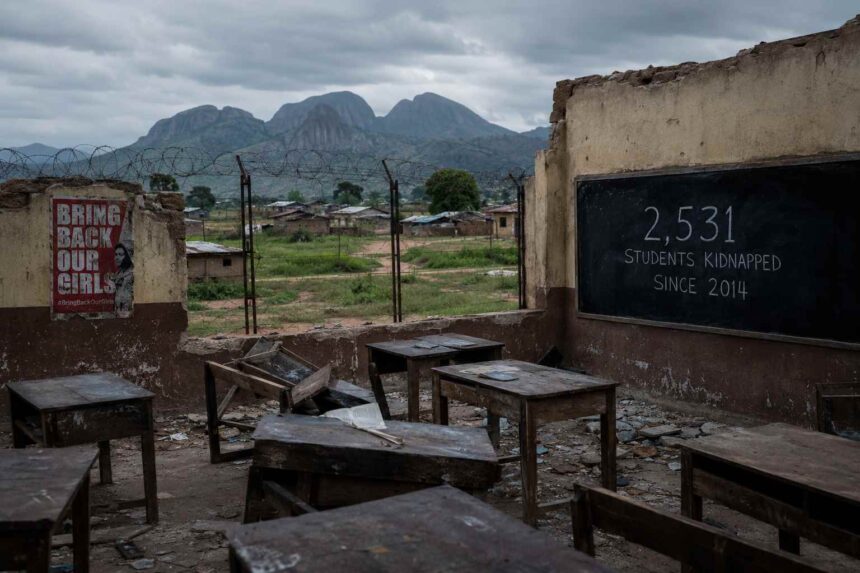
In Nigeria, the safety of schools continues to deteriorate, 12 years after 276 school girls got kidnapped from Chibok. A recent report has revealed that at least 2,531 students were kidnapped in 31 attacks on educational institutions since 2014. In November 2025, a Catholic school in Niger State was the target of the latest mass abduction, in which 315 students and teachers were taken. This incident, alone, outdid the number of Chibok girls when it dropped the world a decade ago.
The trend is obvious and troubling. The attacks, which started off as sporadic incidents in the Northeast, have spread into the rest of northern Nigeria and pose a threat to central areas. Criminal bandits are making use of the technique and making kidnapping a profitable business. Now, parents in Kaduna, Katsina, Zamfara, Niger and Sokoto are fearful their children might not return home from school.
Related News
The Chibok Abduction That Started it All
The kidnapping of the Chibok girls in Nigeria in 2014 has put a sea change in the Nigerian education system. On Sunday 14th April 2014, the Boko Haram attacks a Government Secondary School, Chibok Town, Borno State. On a night nighttime raid, they took 276 female students captive. At that night most of the girls were between 16 and 18 years old.
It was an instant world-renowned phenomenon. Then it was the turn of the US First Lady Michelle Obama to launch her Bring Back Our Girls campaign. Fears grew among the international community that something should be done about the Nigerian government. However, the response was too late and too little. In 2016-2017, just 103 girls were rescued via prisoner exchanges. Eighty two escaped on their own. 91 girls are still missing, and held prisoner, 10-years later.
Following the Chibok tragedy, schools were found to be vulnerable in the midst of conflict situations. It also highlighted government’s failure to protect the citizens from such extremist activities. In response, the Safe School Initiative started with $30 million in initial funding. However, it was halted after the government change in 2015 and the emphasis on national issues.
Related News
The Escalation Years 2018-21.
The escalation period was 2018-2021, with the initial shock being Chibok. A faction of Boko Haram kidnaped 110 school girls from a college in Monguno, Yobe State on February 19, 2018. In the process five girls lost their lives. Most of these were later released, but the attack had demonstrated that extremism had not been quelled.
The actual turning point was in December 2020. A government Secondary School in Kankara, Katsina State was attacked by an armed gang of motorcycle riders. They kidnapped over 300 boys and the incident was the biggest mass kidnapping since Chibok. After discussions with the State government the boys were released after six days. The message was loud and clear, though. Bands of rogues were now making their way to the schools.
The double kidnapping was a blow to the country in February 2021. Gunmen in military uniforms raided a Science college in Kagara, State of Niger on 17th February. There were 27 students and three staff members. Hostages were freed over a week later. The kidnapping of over 300 school girls from a government secondary school in Jangebe, Zamfara State, was nine days later on February 26. All these have been leaked in the last few weeks or weeks following a ransom paid to the attackers.
The fighting escalated to other towns. Gunmen abducted 39 students at the Federal College of Fore Mechanization, Afaka in Kaduna State, on March 11, 2021. They were released in the following weeks. The attack on Private Greenfield University (GU) in Kaduna State was on April 20. 20 or more pupils were kidnapped. Five were killed as they were allegedly in the middle of negotiations with ransom takers. This was the first time that University students were victim of such a large-scale attack.
As of July 2021, over 100 students were kidnapped from Bethel Baptist High School in Chun area of Kaduna State. The students were set free for several months. The pattern was now now very clear. Kidnapping in schools had become a common occurrence in Northern Nigeria.
This Silent and Sudden will return in the year 2022 through 2024.
After the prominent school kidnapping cases of 2021, there was a lull in large-scale reports of school kidnapping cases. Other security issues became the focus of media attention. The quiet was deceiving, however. Abductions were still occurring at high rates and it was getting worse. Save the Children International said, however, that at least 1,683 children had been abducted in Nigeria in the last nine years (2014-2022).
It was silenced in an impressive way in March 2024. At the same time, over 200 Nigerian school students were kidnapped from their school in Kuriga, Chikun Local Government Area of Kaduna State on March 7. Governor Uba Sani has announced on Thursday, March 24, that all the 287 students had been released and they were safe. The attack was blamed on Bakura Doro’s Boko Haram group but criminal bandits were also suspected.
Two days after the Kuriga attack, bandits went to the boarding school in the village of Gidan Bakuso in Sokoto state. While sleeping, they kidnapped 15 children. The crisis did not end in the March 2024 attacks which were back to back. It simply had to wait till the next chance for it to get its head below water.
The kidnapping of the Kuriga was especially disturbing as it occurred during morning assembly. The children could be seen in a school building. This was an indication of total breakdown of security. In this way, armed groups would be able to roam freely and attack schools with impunity.
This is the story of the worst mass abduction in the history of Nigeria, in 2025.
However, November 2025 was the darkest one so far in the school safety crisis in Nigeria. On Monday, 17th November, gunmen attacked a secondary school in Kebbi State, kidnapping 25 girls. An early morning raid was launched six days later on Friday, November 21 at St Mary’s co education boarding school in Papiri, Niger State.
Christian Association of CAN on Saturday confirmed that there were 315 students and educators kidnapped. There were 303 students and 12 teachers in this number. The students’ age range was from 10 to 18 years. The total of abductees was up from Chibok’s 276 making it one of the largest mass abductions in Nigeria’s history.
Some 50 pupils successfully fled just after the attack. About 100 people were released on December 7. That left approximately 165 suspected to be imprisoned. On December 21, however, the Nigerian authorities declared that 130 Catholic school children had been rescued. A U.N. source said that all the people kidnapped have been rescued, with several believed kidnapped having managed to escape during the attack.
The incident was the second mass abduction of schoolchildren in a week this November 2025. This caused worldwide concern and brought the need for government intervention to the fore. Human Rights Watch called for Nigerian authorities to take immediate action to ensure the safe return of students and teachers. They requested specific actions to prevent further attacks to schools and communities.
The Current Toll: What the Numbers Tell Us
The figures are shocking in a 12-year history of abducted pupils in Nigeria. According to Save the Children, there were a minimum of 10 school kidnappings in the past two years, affecting some 670 children. Their 2025 analysis shows the school safety crisis is growing worse.
The figures are based on several sources and vary. As for the number of school children taken captive in infamous kidnappings, the AP reported a minimum of 1,799 students had been seized since 2014. Criminal groups and Islamist extremists have taken at least 1,880 students across Nigeria in the last ten years, DW reported. According to The Cable, at least 2,531 students were kidnapped in 31 school attacks since 2014.
The most conservative estimate from Save the Children International is 1,683 learners abducted from 2014 to 2022. This figure is the average of 210 children abducted each year over eight years. When the years 2023, 2024 and 2025 are added to the list, the actual figure is even higher.
The numbers are even more troubling because they don’t reflect what the world is really like. There are a lot of small scale abductions that go unreported. Pupils from the countryside are no exceptions to the rule that they don’t headline the national media. All incidents do not necessarily count, only when they are noticed by the media.
The perpetrators of kidnapings are not known.
The perpetrators of school kidnappings can be divided into two groups. The first group comprises of Islamist extremist groups, mostly Boko Haram and the splinter groups. Such groups are ideologically driven, and frequently recruit children through abductions and use them as hostages in prisoner exchanges or for forced marriage. The Chibok abduction was a clearly ideologically motivated act of Boko Haram.
The second group is composed of bandits who are involved in criminal activities primarily in the Northwest. These groups are not zealous ideologues but capitalists with a strong sense of profit. The kidnapping of students is mainly for the purpose of extortion of ransom. The Kankara, Jangebe, Kuriga and Niger State abductions have been overwhelmingly blamed on criminal element looking to make money.
These groups are becoming more and more blurred. Criminal kidnap for ransom is now a part of the Boko Haram agenda in some of their fractions. Some criminal bandits have allied with extremists. This convergence further complicates the security issue. The motive can vary but the consequences of the abduction is the same for all children.
The range of the plant is from Northeast to Nation Wide.
The crisis has spread from its initial site. Kidnapping of school girls was mainly in Borno State and the North Eastern region where Boko Haram operated in 2014. The crisis has gone beyond the geopolitical region today. Now the hotspot is the Northwest region which has seen Kano, Abba, Kaduna, Katsina, Zamfara, and Sokoto states witness frequent attacks.
Now, the North Central area is also impacted. In November 2025, they abducted in Niger State, which was a notable geographical extension. The area was relatively quiet before this time, in comparison to the Northwest. The attack was an indicator that bandits are extending their radius.
There have been several large-scale abductions in Kaduna State. The attack on Kankara was in Katsina, the attack on Greenfield University was in April 2021 in Kaduna, the attack on Bethel Baptist High School was in Kaduna in July 2021 and the attack on Kuriga was in March 2024 in Kaduna. Kidnappings of children in schools have become a problem in the state.
The Jangebe kidnapping took place in February 2021 in which more than 300 school girls were abducted from the school in Zamfara State. In March 2024, there was an attack by the Gidan Bakuso in Sokoto State. The Monguno abduction happened in Yobe State, Northeast of the country. The geographical distribution is indicative of it becoming more of a national security issue than a regional issue.
Reflections: A growing crisis
The kidnapping of school girls in Nigeria has not abated in the last 12 years. The case has escalated from an individual tragedy into a systematic abuse of thousands of kids. 31 school attacks have been reported, resulting in at least 2,531 students being kidnapped. The last mass kidnapping in November 2025 was more serious than Chibok in that they abducted more people.
The forward looking statement is not as bright. In February 2026, the Federal Government introduced the Smart School Protection Strategy that emphasises the use of smart security solutions and quick response actions. More than 60,000 of the more than 81,000 schools in the country, however, don’t have adequate security infrastructure, including perimeter fencing. There is a still large divide between policy and implementation.
Children will continue to be targeted if Nigeria does not work on the root causes of banditry, improve security coordination, and invest in school protection. The vicious cycle of abduction, ransom negotiations, ransom payment and another attack needs to stop. The price of inaction is 2,531 children taken and thousands more at risk if things remain the same.