

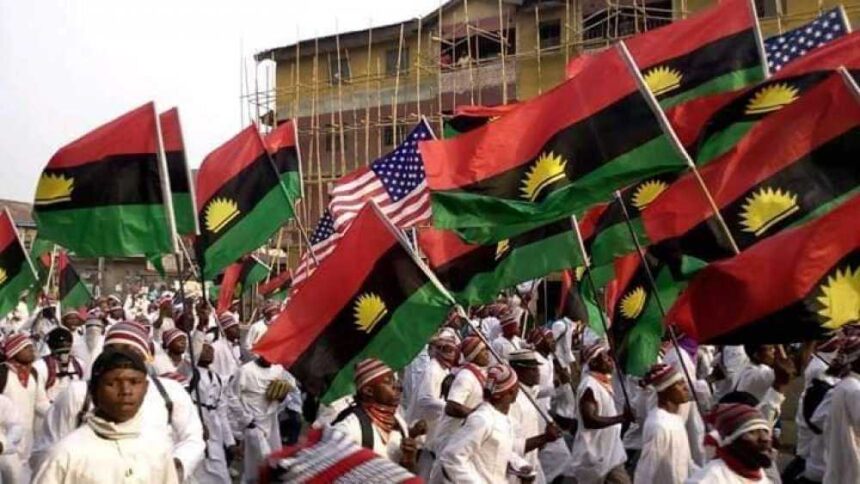
ENUGU — The Movement for the Actualisation of the Sovereign State of Biafra has directed churches across the South-East and South-South geopolitical zones to hold special commemorative services on Saturday, May 31, 2026. The date marks the 59th anniversary of the declaration of the Republic of Biafra by Odumegwu Ojukwu on May 30, 1967.
MASSOB Leader Uchenna Madu issued the directive in a statement released on Monday. He said the commemorative services are an act of remembrance for the millions of Igbo and other people who lost their lives during the Nigerian civil war from 1967 to 1970. He urged churches to hold prayers, reflective sermons, and cultural activities.
“May 30 is a day that every Igbo person and everyone who suffered during the civil war must remember with solemnity. We remember the dead. We reflect on the past. And we recommit ourselves to the pursuit of justice and equity for our people,” Madu said in the statement.
Related News
MASSOB clarified that the directive targets May 31 rather than May 30 this year because May 29 is Democracy Day, a federal public holiday, and May 30 falls on a Friday. The organisation said adjusting to Saturday ensures maximum church participation without conflict with the public holiday.
Biafra Commemoration in Context
The annual commemoration of the Biafra declaration remains a deeply sensitive subject in Nigerian public life. The Nigerian civil war, which ended in 1970 with more than one million deaths by most estimates, left profound wounds across the Igbo-speaking southeast and beyond.
Related News
Successive Nigerian governments have taken different positions on how the war should be remembered. The official narrative emphasises reconciliation and the unity of Nigeria. Many Igbo communities, particularly those affiliated with MASSOB and IPOB, say that genuine reconciliation requires honest acknowledgment of the suffering their people endured.
Furthermore, the Biafra issue remains politically sensitive ahead of 2027. Several Igbo political leaders have linked the question of presidency returning to the southeast to broader demands for justice and inclusion. Some argue that a southern or Igbo presidency would go further toward healing civil war-era divisions than any symbolic gesture.
Government’s Position
The Federal Government has not formally responded to MASSOB’s directive. Security agencies typically increase surveillance during Biafra commemoration events, monitoring for any activities that might cross the line from peaceful remembrance into separatist agitation.
MASSOB is distinct from IPOB, which is designated as a terrorist organisation by the Nigerian government. MASSOB has historically pursued its goals through civic activism rather than armed struggle. Its church-directed commemorative activities are unlikely to trigger a government response as long as they remain peaceful.
Christian Association of Nigeria and the Catholic Bishops Conference of Nigeria have both previously called for honest dialogue about the legacy of the civil war. Some church leaders in the southeast have expressed support for commemorative services as an act of historical memory rather than political agitation.