

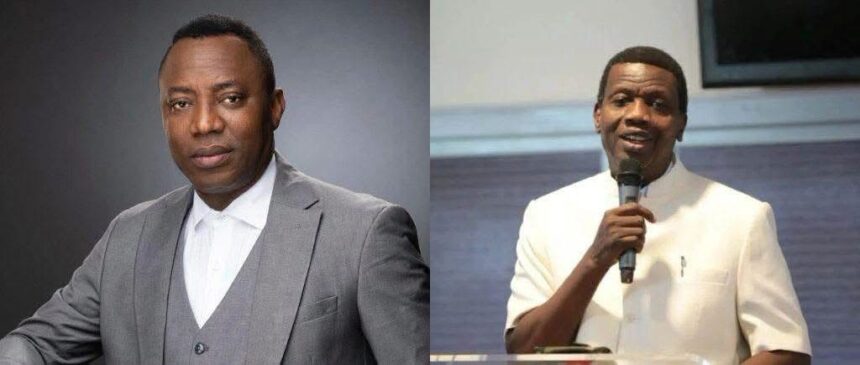
ABUJA, Nigeria — African Action Congress (AAC) presidential candidate Omoyele Sowore has revealed details of his recent private meeting with the General Overseer of the Redeemed Christian Church of God (RCCG), Pastor Enoch Adeboye, including the cleric’s reported assurance that he regularly prayed for him and believed he would triumph.
Sowore shared the account during an interview on the Naija Unfiltered Podcast, where he reflected on his encounter with the respected Nigerian pastor following the church’s National Thanksgiving Service at its headquarters in Ebute-Metta, Lagos State.
According to Sowore, the meeting was significant because it brought him back into contact with Adeboye about 30 years after their first encounter in 1996.
Related News
The activist’s account has drawn attention to the relationship between the two men, particularly because their recent conversation reportedly centred on personal recognition, prayer and a shared memory from their earlier meeting rather than political discussions.
Recounting the conversation, Sowore said Adeboye recognised him and told him that he had been praying for him regularly.
The AAC candidate quoted the cleric as saying he knew him well, considered his ways pure and believed he would triumph.
Related News
The remarks, as reported by Sowore, formed the central part of the encounter he described during the podcast interview.
For Sowore, the conversation was also an opportunity to revisit a relationship that began long before his current political activities attracted national attention.
The activist explained that he was initially asked to wait near Adeboye’s car after the thanksgiving service. He was subsequently informed that the cleric wanted to meet him inside the church’s vestry.
The private meeting provided an opportunity for the two men to speak away from the main gathering.
Sowore had earlier disclosed the encounter in a post on X after attending the church service, noting that Adeboye had offered to pray for him.
Beyond the recent meeting, Sowore recalled that his first encounter with Adeboye took place in 1996, shortly after he completed his National Youth Service Corps (NYSC) programme.
According to him, he approached the cleric at the time to seek support for a campaign against cultism in Nigerian universities.
Campus cultism was a major concern for students, parents and university authorities, with the activities of secret groups raising fears about violence and safety in higher institutions.
Sowore said he wanted Adeboye to support efforts to discourage young people from joining such groups and to help address the problem on university campuses.
He recalled that the pastor supported the initiative and directed that N10,000 be given to him to fund the campaign.
Sowore said the money was used for the anti-cultism campaign.
The recollection adds historical context to the recent encounter, showing that their first reported interaction was connected to a social campaign rather than an electoral contest.
It also highlights an earlier period in Sowore’s public life, when he said he was seeking support for an initiative aimed at addressing a problem affecting Nigerian students.
During the recent meeting, Sowore said Adeboye asked for permission to pray for him.
He agreed to the request but told the cleric that he would keep his eyes open during the prayer. According to his account, Adeboye proceeded with the prayer, after which they stood up and laughed together.
The exchange reflected a cordial interaction between the two men, although Sowore made it clear that accepting the prayer did not mean he had changed his position on organised religion.
When asked whether he had given his life to Christ during the encounter, Sowore said the discussion had not gone in that direction.
He explained that he was not involved in organised religion and maintained that the conversation with Adeboye did not include a discussion about religious conversion.
His response clarified the distinction between accepting a personal offer of prayer and making a formal religious commitment.
The account also underlined that the two men could have a conversation despite their different positions on organised religion.
Sowore also said he did not discuss his presidential ambition with Adeboye during their private conversation.
This detail is significant given his position as an AAC presidential candidate and the public attention that can follow interactions between political figures and prominent religious leaders in Nigeria.
Major churches often attract public officials, politicians and other influential personalities to their services. Such encounters can generate questions about political intentions, endorsements and relationships between religious institutions and public office seekers.
However, Sowore described his meeting with Adeboye as a personal conversation. He did not present it as a political consultation or an endorsement of his presidential ambition.
There is therefore no basis, from his account alone, to conclude that the cleric endorsed his candidacy or agreed to support his political campaign.
The reported exchange centred on prayer, their previous meeting and the recognition of a relationship that began three decades earlier.
The meeting brings together two prominent Nigerians known for different roles in public life.
Adeboye leads the RCCG, one of Nigeria’s major Christian organisations, while Sowore is known for his activism, political participation and criticism of government policies.
Their interaction has attracted interest because it combines religion, political identity and a historical connection dating back to the 1990s.
For observers, the account also raises a broader question about how public figures with different beliefs and professional backgrounds maintain personal relationships.
Sowore’s description suggests that the recent meeting was not primarily about politics but about reconnecting with someone he first approached for support during an anti-cultism campaign.
The cleric’s reported offer to pray for him became the most notable part of the encounter, while the recollection of their first meeting provided additional context.
Ultimately, the details available about the meeting come largely from Sowore’s own account during the podcast interview and his earlier public comments. Adeboye’s reported statements should therefore be understood in that context.
The encounter does not, by itself, establish a political alliance or religious conversion. Instead, it offers a glimpse into a personal conversation between two public figures whose paths first crossed during an effort to address campus cultism in Nigeria.
Their meeting in Lagos, approximately three decades after that first encounter, has renewed attention on a relationship that Sowore says began with a request for support for a social cause.
Source: Sowore’s interview on the Naija Unfiltered Podcast and his public comments following the RCCG National Thanksgiving Service, as reported by Nigerian news outlets.